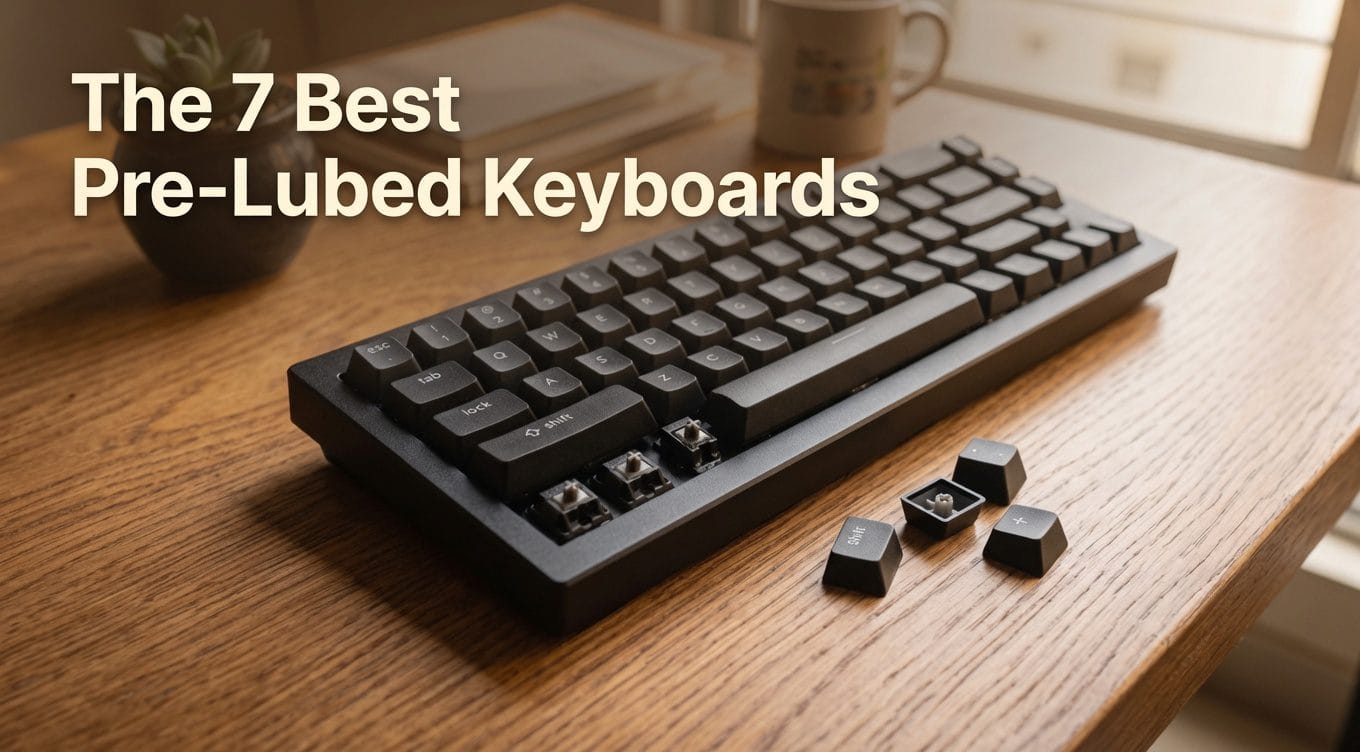
The 7 Best Pre- Lubed Keyboards for a Modded Sound Out of the Box (2026)
Search “pre lubed keyboard” and the results assume you want homework. Bags of loose switches. Tubes of Krytox. A forty-minute brush-lubing tutorial.
That’s not what most people typing that query want. You want a board that sounds and feels modded straight out of the box — no desoldering, no switch films, no Saturday lost to stabilizer surgery.
Those boards exist. But the market around them is a mess of mislabeled switch types, half-quoted force specs, and “pre-lubed” claims that quietly skip the stabilizers — the real rattle culprit. Every claim below traces to a named source.
The Keychron Q5 Max is the strongest pre-lubed keyboard for most buyers. Its factory-lubed Gateron Jupiter switches and factory-lubed screw-in stabilizers deliver a modded, custom-shop feel with zero DIY — a quality multiple independent reviewers place at the top of the premium prebuilt class. The Corsair K70 CORE and AULA F75 capture most of that feel for far less.
Our Quick Verdict
- Best Overall — Keychron Q5 Max. Factory-lubed Jupiter switches and screw-in stabilizers on a full-metal 96%; reviewers call the stock feel near-custom (Phandroid; PCWorld).
- Best Full-Size Under $100 — Corsair K70 CORE. A Tom’s Hardware reviewer called its pre-lubed 45 g MLX Red the smoothest stock switch he’d used on a mainstream board.
- Best Wireless Gaming — ASUS ROG Strix Scope II 96. Pre-lubed NX Snow linears, spec-sheet-lubed stabilizers, ~1,500-hour battery lights-off (Tom’s Hardware; ASUS).
- Best Low-Profile — NuPhy Air75 V3. RTINGS-tested; factory-lubed Nano switches, pre-lubed stabilizers, unusually deep 3.5 mm travel (Tom’s Guide).
- Best Budget With Enthusiast Features — Epomaker Shadow-X. TechPowerUp’s teardown confirmed factory-lubed switches AND stabilizers — photographed, not claimed.
- Best Value — AULA F75. Pre-lubed Leobog Reaper linears, both forces published (45±3 g / 55±3 g), sub-$70 street band (The Phonograph).
- Best for Typists — Akko 5075B Plus. One reviewer rated its factory lube among the best he’d felt on any prebuilt; tactile Cream Blue Pro option. Sourced thinner, so we hedge (GBAtemp).
Pre-Lubed Keyboard vs Pre-Lubed Switches: Which Are You Actually After?
Most pages ranking for this query sell loose switches or a lubing tutorial. Get clear on which product you need first.
What “pre-lubed” means — and why stabilizers matter more
Pre-lubed switches are a loose component you install yourself — which requires a hot-swap board or a soldering iron. A pre-lubed keyboard arrives assembled, lubed switches installed and, on the good ones, factory-lubed stabilizers too.
That second part is the one that matters. Switch lube fixes scratchiness and spring ping; stabilizer lube fixes rattle — the spacebar-and-enter clatter that makes a board sound cheap. Every board below was checked on both counts; the results weren’t uniform.
When loose pre-lubed switches are the better buy
Already own a hot-swap board you like? Pre-lubed switches (Gateron’s Oil Kings, per Kinetic Labs) are the cheaper upgrade path. Starting from zero, buy the assembled board.
How We Picked (and What Factory Lube Really Buys You)
Every board cleared the same gates: sold on Amazon US, backed by at least three independent credible reviews (top picks have five-plus), confirmed as the current model, and re-checked against manufacturer documentation.
Factory-lube quality vs consistency: the QC reality
Factory lube used to be a punchline. Kinetic Labs’ lubing guide notes it was historically hit-or-miss — but recent factory-lubed lines are genuinely smooth out of the box, sometimes so heavily lubed they feel too smooth for people who like texture.
The catch is consistency. Machines apply lube fast, not perfectly: PCWorld’s Q-Max reviewer hit backspace-stabilizer rattle on a board costing over $200. A pre-lubed board removes 95% of the work; the last 5% is the arrival inspection further down this page.
Does factory lube wear off?
Not in any way you should plan around. Kinetic Labs notes good factory lube lasts a long time, and some switch designs redistribute their lube with use, smoothing out over the first weeks.
The Best Pre-Lubed Keyboards at a Glance
| Product | Best For | Price band | Third-party score | Switch (official type) | Force (act. / bottom-out) | Mounting | Hot-swap | Connectivity | Stabs factory-lubed? |
| Keychron Q5 Max | Best overall | $220 | RTINGS best-list placement | Gateron Jupiter Red (linear) | 45 g / 50–60 g (disputed) | Double-gasket | Yes (stock 3-pin) | 2.4 GHz + BT + wired | Yes — widely reported; QC-variable |
| Corsair K70 CORE | Full-size under $100 | Price varies by retailer | n/a | Corsair MLX Red (linear) | 45 g / not published | Not stated (alu plate, dual EVA foam) | No — soldered | Wired only | Not independently verified |
| ASUS Scope II 96 | Wireless gaming | $205 | n/a | ROG NX Snow (linear) | 45 g / 53 g (40 g initial) | Not stated (pads + foam) | Yes (power off first, per ASUS) | Tri-mode | Yes — on ASUS’s spec sheet |
| NuPhy Air75 V3 | Low-profile | $140 | Crafting Worlds 8.8/10 | Red Nano (LP linear) | UNVERIFIED (NuPhy spec) | Gasket | Not confirmed | Tri-mode | Yes — plate-mount, reviewer-confirmed |
| Epomaker Shadow-X | Budget, enthusiast internals | $86 | n/a | Flamingo / Bluebird / Gateron Pro Yellow (linear) or Budgerigar (tactile) | Budgerigar: 55 g / 60 g | Gasket (silicone, PC plate) | Yes — 5-pin, south-facing | Multi-mode (knob-switched) | Yes — teardown-confirmed |
| AULA F75 | Best value | $75 | n/a | Leobog Reaper (linear) | 45±3 g / 55±3 g | Leaf-spring gasket | Yes — 3/5-pin | Tri-mode | Yes — reported rattle-free |
| Akko 5075B Plus | Typists / tactile | $110 | n/a (low-source) | V3 Cream Blue Pro (tactile) | UNVERIFIED (Akko spec) | Gasket (PC plate) | Yes — 3/5-pin | Tri-mode (Beken Plus) | Lubed, but clip-ins sit loose |
The 7 Best Pre-Lubed Keyboards
1. Keychron Q5 Max — Best Overall
A custom build eats a weekend and a lube station. The Q5 Max is Keychron’s argument that you can skip both: a full-metal 96%, roughly 2.2 kg, double-gasket mount, acoustic foam, factory pre-lubed Gateron Jupiter switches over screw-in stabilizers.
Core specs
- Switch: Gateron Jupiter Red, linear, 3-pin, 80M-keystroke rating; Brown/Banana tactile options
- Force: 45 g actuation (agreed); bottom-out reported 50–60 g depending on source — see matrix
- Mount: double-gasket plus foam; hot-swap; double-shot PBT keycaps
- Stabilizers: screw-in, widely reported factory-lubed — not officially stated by Keychron
- Connectivity: 2.4 GHz (1,000 Hz) / Bluetooth / USB-C; QMK/VIA
- Research trap: the wired Q5 and Q5 Pro use different switches — don’t carry their specs over
Acoustic Profile & Typing Feel
Phandroid describes lube that reads as hand-applied — no spring ping, muted-but-crisp, an out-of-box feel it summed up as near-custom. PCWorld’s Q-Max review found the lubed Jupiters exceptionally smooth, then hit backspace-stab rattle on its unit: quality is high, consistency isn’t guaranteed.
Pros
- Factory-lubed switches and screw-in stabilizers; reviewers call the stock feel near-custom
- Double-gasket mount plus foam; no case ping reported
- QMK/VIA with 1,000 Hz wireless polling; 96% keeps the number pad compact
Cons
- Premium price band
- One review unit had backspace-stab rattle — QC varies
- Scattered fast-typing registration reports; at ~2.2 kg, desk-only
Best for: the buyer who wants the full modded package with zero intention of ever opening the case.
Verdict: Stack the sources — Phandroid’s near-custom assessment, PCWorld’s premium-class standing, an RTINGS best-list placement — and the Q5 Max is the closest a prebuilt gets to a custom build you didn’t have to build.
2. Corsair K70 CORE — Best Full-Size Under $100
Mainstream gaming boards are where scratchy stock switches live. This wired full-size is the exception reviewers keep pointing at: factory pre-lubed MLX Reds under an aluminum top plate, two EVA foam layers doing the acoustic work.
Core specs
- Switch: Corsair MLX Red, linear, factory pre-lubed, soldered
- Force: 45 g / 1.9 mm / 4.0 mm travel / 70M (Corsair official); bottom-out not published
- Dampening: two EVA foam layers; aluminum top plate; double-shot ABS keycaps
- Connectivity: wired only, fixed cable
- Naming trap: CORE = MLX Red; CORE TKL/Wireless = MLX Red v2; K70 PRO = optical OPX; K70 MAX = magnetic MGX — match the exact SKU
Acoustic Profile & Typing Feel
Tom’s Hardware’s reviewer called the pre-lubed MLX Reds the smoothest stock switches he had used on a mainstream board — no case ping, and a 45 g weight that never felt heavy. PCWorld rated the deep, flat, quiet signature the best typing of any Corsair board; Trusted Reviews counters that heavy typists may find it slightly muddy.
One published error to correct: Trusted Reviews calls the switches hot-swappable — they’re not; Corsair confirms the MLX Red is soldered.
Pros
- Smoothest stock switch on a mainstream board at this price, per Tom’s Hardware’s reviewer
- Dual EVA foam, no case ping — unusually quiet for full-size gaming
- Aluminum top plate and a tight, published spec sheet
Cons
- Fixed, non-detachable cable
- Not hot-swappable — soldered, despite one review claiming otherwise
- Damping can read slightly muddy to heavy typists; no published bottom-out force
Best for: anyone who needs a full-size layout with office-quiet acoustics and no interest in changing switches.
Verdict: At 45 g and carrying the strongest stock-switch praise Tom’s Hardware has handed a mainstream board, the K70 CORE is the easy full-size answer.
3. ASUS ROG Strix Scope II 96 Wireless — Best Wireless Gaming
Gaming keyboards talk RGB and ignore stabilizers. ASUS did the opposite: the stabilizer lube is printed on the official spec sheet of this tri-mode 96%, which runs NX Snow linears over dampening pads and foam.
Core specs
- Switch: ROG NX Snow, linear, pre-lubed stems and housings (ASUS); sibling NX Storm is officially clicky
- Force: 40 gf initial / 45 gf actuation at 1.8 mm / 53 gf bottom-out; 3.6 mm total travel — shorter than the standard 4 mm
- Stabilizers: pre-lubed per ASUS’s spec sheet; dampening pads, foam, aluminum top plate
- Battery: ~1,500 hours with lighting off (Tom’s Hardware)
- Keycaps: double-shot PBT or UV-coated ABS by SKU — check the listing
Acoustic Profile & Typing Feel
Those three force numbers — 40, 45, 53 gf — don’t contradict each other: initial force, actuation point, bottom-out. Three points on one curve, not competing claims.
Tom’s Hardware describes a refined, ping-free linear; Root-Nation praised the long-key stabilization — no wobble, rattle, or ring — while DigitalCitizen found the spacebar slightly wobbly. The recurring complaint isn’t hardware: Tom’s Guide reported Armoury Crate hanging and failing to detect the keyboard.
Pros
- Pre-lubed switches plus spec-sheet-lubed stabilizers — rare for a gaming board
- Around 1,500 hours of battery with lighting off
- Dampening pads and foam; clean, ping-free sound per multiple reviews
Cons
- Armoury Crate hangs and detection failures (Tom’s Guide)
- 96% layout feels cramped to some reviewers
- Spacebar wobble on some units; keycap material varies by SKU
Best for: the wireless gamer who wants enthusiast acoustics, a near-full layout, and months of battery — and can tolerate clunky software.
Verdict: Unlike almost every gaming board in its class, this one puts lubed stabilizers on the manufacturer spec sheet — add the documented 1,500-hour battery and the Scope II 96 earns its slot outright.
4. NuPhy Air75 V3 — Best Low-Profile
Low-profile boards usually trade typing feel for thinness. The Air75 V3’s trick is 3.5 mm of switch travel — near full-size depth — in a slim gasket-mounted chassis, running factory-lubed Gateron LP Nano switches over pre-lubed plate-mount stabilizers (Damian Cooper confirms the stabilizer detail).
Core specs
- Switch: Gateron LP Nano — Red (linear), Brown (tactile), Blush (silent linear — dampened, NOT tactile; listings regularly botch this)
- Verified: ~1.7 mm actuation, 3.5 mm travel (TweakTown)
- Mount: gasket; plate-mounted stabilizers, pre-lubed
- Build: CNC aluminum top / ABS bottom; double-shot PBT keycaps
- Battery: 4,000 mAh, ~1,200 hours with lighting off; tri-mode
Acoustic Profile & Typing Feel
Tom’s Guide describes a creamy sound and a feel far closer to a standard board than low-profile buyers expect — the payoff of that 3.5 mm travel. RTINGS has the V3 on its tested list, settling the concern that serious coverage only existed for the V2.
Crafting Worlds scored it 8.8/10 while asking for more switch options and a steadier knob. Cooper adds a practical note: this board is not designed to be opened, so what ships is what you keep.
Pros
- Factory-lubed low-profile switches plus pre-lubed plate-mount stabilizers — verified, not assumed
- 3.5 mm travel, unusually deep for low-profile
- RTINGS-tested; roughly 1,200 hours of battery with lighting off
Cons
- Limited switch options at launch; heavier than the V2
- Not designed to be opened or modified
- Knob stability drew criticism (Crafting Worlds)
Best for: Mac users, commuters, and anyone who wants slim without the shallow, dead feel low-profile usually implies.
Verdict: RTINGS’ tested list plus two V3-specific reviews put the Air75 V3 in rare low-profile company — verified factory lube, 3.5 mm of travel, and stabilizers lubed at the factory rather than left to luck.
5. Epomaker Shadow-X — Best Budget With Enthusiast Features
Marketing pages claim “pre-lubed” all the time. TechPowerUp took this board apart and photographed it: the teardown confirmed factory-lubed plate-mounted stabilizers and Budgerigar tactiles lubed on stem and spring — sides included.
Core specs
- Switch options: Flamingo, Bluebird, or Gateron Pro Yellow (linear), Budgerigar (tactile) — the black colorway launched with Budgerigar; confirm your variant
- Budgerigar force: 55 g actuation / 60 g bottom-out, 47 g double-stage spring; nylon housing, long-pole POM stem (Tech4Gamers)
- Stabilizers: plate-mounted, factory-lubed — teardown-confirmed (TechPowerUp)
- Mount: 70% FRL TKL; gasket with silicone around a PC plate; Poron + IXPE foam; display + mode knob; 3,000 mAh
- Hot-swap: 5-pin, south-facing; double-shot PBT keycaps with 1.35 mm walls
Acoustic Profile & Typing Feel
Tech4Gamers logged minimal stem wobble and consistent factory lube on the Budgerigar, its double-stage spring giving the bump a defined start. Prime Audio’s reviewer ranked the Bluebird linear among the best he had used; The Phonograph lands on the sound — thocky, deep, switches and stabilizers both lubed.
The compromises are ergonomic, not acoustic: the PC plate sits stiffer than the gasket mount suggests (Prime Audio), and at roughly 900 grams this is not a travel board (MakeUseOf).
Pros
- Factory-lubed switches AND stabilizers, confirmed by an independent teardown
- Gasket mount, PC plate, layered foam at a sub-$90 price
- 5-pin south-facing hot-swap; both Budgerigar force figures published
Cons
- No PgUp key (The Gadgeteer)
- Knob switches connection modes, not volume — a repeated reviewer gripe
- Clunky driver software (MakeUseOf); FRL layout wastes desk space
Best for: the budget buyer who wants proof, not promises — teardown-verified internals with a genuine tactile option under $90.
Verdict: A TechPowerUp teardown beats any marketing page, and it confirms exactly what the Shadow-X claims — lubed switches, lubed stabilizers, real foam — at a price undercutting everything above it.
6. AULA F75 — Best Value
Reddit’s keyboard communities crowned this the budget board to beat, per Vrkaa’s sampling — and unusually for the bracket, the spec sheet backs the reputation up.
Core specs
- Switch: Leobog Reaper, linear, factory-lubed, 5-pin; POM stem, PC top, nylon base
- Force: 45±3 gf / 55±3 gf, 1.8 mm pre-travel, 3.6 mm travel — both figures published (The Phonograph)
- Stabilizers: pre-lubed; reported 100% rattle-free (The Phonograph, F75 Max)
- Mount: leaf-spring gasket; flex-cut PC plate; five-layer dampening (two Poron, IXPE, PET, bottom silicone)
- Battery: 4,000 mAh, ~80 hours lights off; tri-mode; hot-swap 3/5-pin; PBT Cherry-profile caps
Acoustic Profile & Typing Feel
Damian Cooper’s review describes the Reaper as creamy and thocky straight out of the box, factory-lubed and tuned. Vrkaa’s switch guide adds a clarification gamers need: this is a standard mechanical board, not Hall-effect — no rapid trigger, despite persistent confusion.
Watch the model sprawl: F75, F75 Pro, F75 Max (TFT screen), F87 Pro, and F99 share the name, with “Epomaker x AULA” as the US co-brand. The most common arrival complaint, per Vrkaa’s Reddit sampling: bent switch pins — easy to fix on a hot-swap board, so check before you type.
Pros
- Pre-lubed Reaper linears with both forces published at a tight ±3 g tolerance
- Pre-lubed stabilizers reported completely rattle-free
- Five-layer dampening and leaf-spring gasket mount at an affordable price point
Cons
- Bent switch pins are the most common arrival complaint in community reports
- Knob wobbles slightly (Damian Cooper); ABS case, not metal
- No Hall-effect, rapid trigger, or SOCD — wrong board for spec-chasing competitive FPS
Best for: a first mechanical keyboard, a spare board, or the modded sound at minimum spend.
Verdict: Two published force figures, stabilizers reported rattle-free, and a sub-$70 street band — no other board here delivers that ratio of verified spec to price.
7. Akko 5075B Plus — Best for Typists
This is the roster’s dedicated tactile pick — and the one entry we recommend with a visible asterisk.
The asterisk first: no RTINGS- or TechPowerUp-grade lab review of this exact board exists, so the sourcing leans on enthusiast outlets — GBAtemp, Nextrift, geekyminded — plus Akko’s spec sheet. Credible, but thinner than the rest. What they agree on is striking: GBAtemp’s reviewer rated the factory lube among the best he had felt on any prebuilt.
Core specs
- Switch (this slot): Akko V3 Cream Blue Pro, tactile
- Linear alternatives: V3 Cream Yellow Pro; V3 Silver Pro at 40±5 gf, 1.0 mm pre-travel, 3.3 mm travel (Akko spec)
- Mount: gasket; PC plate; IXPE switch pad plus silicone plate and case foam
- Hot-swap: 3/5-pin; double-shot PBT keycaps, ASA profile; 3,000 mAh; Beken Plus tri-mode
Acoustic Profile & Typing Feel
Nextrift tested the Cream Blue Pro and describes a rounded, unaggressive bump over soft gasket typing; geekyminded found the resistance biased toward the top of the stroke and rated the typing experience near the top of its class. GBAtemp’s unit — which shipped with Akko White Wine switches, so the lube praise speaks to Akko’s factory work broadly — produced a deep, clacky sound with no modding.
The known nit, confirmed twice: the clip-in stabilizers arrive lubed but sit loose on the plate — Nextrift and Akko’s own user reviews report spacebar looseness or rattle on some units. A two-minute re-seat fixes it.
Pros
- Standout factory-lube quality, per the strongest available review
- Tactile V3 Cream Blue Pro option — the only dedicated pre-lubed tactile pick here
- Gasket mount, PC plate, layered silicone foam; 3/5-pin hot-swap
Cons
- Clip-in stabilizers sit loose on the plate; spacebar rattle reported by multiple sources
- Heavy to carry (geekyminded); weak software and Mac support
- Thinner independent review coverage than every other board here
Best for: typists who want a pre-lubed tactile and don’t mind re-seating a stabilizer if needed.
Verdict: One reviewer’s opinion isn’t consensus, so take this as a hedged pick — GBAtemp rated the factory lube among the best felt on a prebuilt, and Nextrift’s stabilizer finding tells you exactly what to inspect on arrival.
Where the Sources Disagree: The Cross-Source Force Matrix
No competing page aggregates named lab data on the pre-lube angle, so we built the record ourselves — and where sources conflict, we show the conflict.
| Product | Named published scores | Force data across sources |
| Keychron Q5 Max | RTINGS best-list; PCWorld and Phandroid qualitative | Jupiter Red actuation: 45 g, agreed. Bottom-out disputed: 50 g (KeebWorks force curve) / 54 g (SwitchOddities) / 60 g (Milktooth, mfr-aligned) |
| Corsair K70 CORE | Tom’s Hardware and PCWorld qualitative | 45 g actuation (Corsair plus five reviews); one 50 g outlier (TweakTown, SE model). Bottom-out: not published |
| ASUS Scope II 96 | RTINGS reviewed; Tom’s Hardware, Tom’s Guide | 40 gf initial / 45 gf actuation / 53 gf bottom-out — three points on one curve |
| NuPhy Air75 V3 | Crafting Worlds 8.8/10; RTINGS tested | 1.7 mm actuation, 3.5 mm travel verified (TweakTown); gram-force unverified |
| Epomaker Shadow-X | TechPowerUp teardown (no numeric score) | Budgerigar 55 g / 60 g — published, undisputed |
| AULA F75 | RTINGS anchor review | Reaper 45±3 g / 55±3 g — published, tight tolerance |
| Akko 5075B Plus | GBAtemp qualitative (low-source) | Cream Blue Pro force unverified; Silver Pro published at 40±5 g |
The Jupiter Red row is the lesson. A 10-gram spread on bottom-out is the gap between a light and a medium linear — when a review calls a switch “creamy” without stating which figure it worked from, that adjective is doing unsupported work.
Stabilizer-lube verification: what we could actually confirm
The check nearly every competing page skips:
- Verified factory-lubed: ASUS Scope II 96 (official spec sheet), NuPhy Air75 V3 (reviewer-confirmed), Epomaker Shadow-X (teardown-confirmed), AULA F75 (spec plus rattle-free report)
- Factory-lubed with QC variance: Keychron Q5 Max — widely reported lubed, not officially stated, one reviewed unit rattled
- Lubed but loose: Akko 5075B Plus — clip-ins arrive lubed but sit loose on the plate
- Switch lube praised, stabilizer lube not independently verified: Corsair K70 CORE
What Actually Matters When Choosing a Pre-Lubed Keyboard
Demand the exact switch name and official type. Listings mislabel constantly — a silent linear is not a tactile; the Blush Nano and Corsair’s four-way K70 naming both trip buyers.
Insist on two force numbers. Actuation and bottom-out describe different moments in a keypress; a single unlabeled “45 g” tells you almost nothing.
Stabilizers decide the sound more than switches do. Spacebar, enter, and backspace carry every sentence. If “pre-lubed” only means switches, you may still get the rattle you paid to avoid.
Mounting and foam are the other half of “sounds modded.” Gasket mounts and layered foam produce the muted, deep thock signature. That’s dampening, not silence.
Hot-swap decides your exit route. The Corsair’s soldered switches are permanent; the Shadow-X’s 5-pin sockets mean you can change your mind for $20.
Assume unit variance. A $220 board rattled in one professional review; a $65 board’s most common complaint is bent pins. Factory lube is real, and so is factory inconsistency.
What to Check the Moment Your Pre-Lubed Keyboard Arrives
Five checks, two minutes, before you throw away the box:
- Tap-test spacebar, enter, and backspace for rattle — worst logged offenders: the Akko’s loose clip-ins and isolated Keychron backspace reports.
- On hot-swap budget boards, pull two or three switches and inspect the pins — the most common AULA F75 arrival complaint.
- Press a handful of keys slowly: a sluggish, sticky return suggests over-lube; audible scratch suggests a switch the machine missed.
- Listen for spring ping in a quiet room — slow presses across the top row expose it fastest.
- Confirm which switch variant actually shipped — the Shadow-X and the Akko both sell multiple types under one product page.
FAQ
What’s the difference between a pre-lubed keyboard and pre-lubed switches?
Pre-lubed switches are a loose component — bought in packs, installed yourself, requiring a hot-swap board or soldering. A pre-lubed keyboard arrives assembled with lubed switches and, on the better boards, factory-lubed stabilizers too. Own a board you like? Buy switches. Starting fresh? Buy the board.
Are pre-lubed keyboards actually good, or is it marketing?
Mostly good, now. Kinetic Labs notes factory lube was historically hit-or-miss but recent factory-lubed lines are genuinely smooth out of the box — Tom’s Hardware’s praise for the $100 Corsair K70 CORE’s stock switches is the clearest evidence. Consistency still varies unit to unit.
Does the Keychron Q5 Max come with lubed stabilizers too, or just switches?
The switches are officially pre-lubed. The screw-in stabilizers are widely reported factory-lubed as well, but Keychron doesn’t officially state it, and PCWorld’s review unit had audible backspace rattle. Expect lubed stabilizers — and tap-test them on arrival anyway.
Is the Corsair K70 CORE hot-swappable?
No. Corsair confirms the MLX Red switches are soldered — one major review claimed otherwise in error. The switches are pre-lubed but permanent, so buy this board only if you’re happy with the MLX Red long-term.
Which pre-lubed keyboard is best on a budget?
The AULA F75, in a sub-$70 street band, ships pre-lubed Reaper linears with both forces published and stabilizers reported rattle-free. One step up, the Epomaker Shadow-X adds teardown-verified stabilizer lube, 5-pin hot-swap, and a tactile option.
Do the stabilizers rattle on the Akko 5075B Plus?
Sometimes. They arrive factory-lubed, but the clip-in design sits loose on the plate — Nextrift and Akko’s own user reviews both report spacebar looseness on some units. Re-seating or tightening them is a known two-minute fix.
How We Researched This
This guide was compiled using a synthesis-based research methodology. Technical specifications come from official manufacturer spec sheets. Acoustic and typing-feel observations are drawn from published independent reviews (cited by name where they exist) and from the wider mechanical-keyboard enthusiast community.
No hands-on units were physically tested for this guide. Instead, we cross-referenced technical data and reviewer findings across multiple independent sources to compile an objective, comparative analysis. Where a claim reflects a manufacturer’s own rating rather than an independent measurement, we say so. For more details on our standards, please visit our dedicated Methodology page.
Pick Your Lane and Stop Scrolling
One thing to take from all of this: the stabilizers are the part to interrogate, and only a handful of boards survive that question with evidence.
The Keychron Q5 Max survives it best — factory-lubed Jupiter switches, factory-lubed screw-in stabilizers, and a 1,000 Hz wireless chassis multiple independent reviewers place at the top of the premium prebuilt class. On a budget, the answer flips to the AULA F75: both forces published at ±3 g tolerance, stabilizers reported completely rattle-free, sub-$70.
Whichever lane fits, run the two-minute arrival checklist, keep the box for the return window — and enjoy never learning what a switch opener is.