What Are IEM Headphones? The Electromechanical Truth
Let’s be real. In the fast-moving personal audio industry, the search for absolute reproduction and high-fidelity sound often leads to a single, inevitable question. What are IEM headphones, and why have they entirely cannibalized the high-end audiophile market?
For decades, bulky over-ear studio monitors dominated the personal audio gear space. Today, this sector is completely different. Resin-cast shells no larger than a pebble are consistently outperforming flagship circumaural headphones. This is not acoustic magic. It is raw, calculated electromechanical engineering.
To understand the mechanics behind this shift, we must strip away subjective marketing fluff and get straight to the metrology. Testing methodologies utilizing modern, anatomically accurate simulators like the Brüel & Kjær Type 5128 have exposed the glaring flaws in legacy audio testing.
Older IEC 60318-4 (711) couplers fundamentally failed to accurately map the acoustic input impedance of the human ear, leading to decades of poorly tuned consumer hardware. When measured on modern rigs, the data is undeniable. IEM headphones bypass the outer ear entirely, utilizing the ear canal as a closed pneumatic pressure chamber to deliver acoustic transients with microscopic precision.
This report dismantles the underlying technology, the physiological interactions, and the specific driver topologies that define modern audio delivery.
Quick Answer:
IEM headphones sit directly inside your ear canal, creating an airtight seal that delivers sound straight to your eardrum. Unlike regular earbuds, there’s zero acoustic leakage giving you pinpoint imaging, deep noise isolation, and transient speed no over-ear headphone can match.
Used by musicians, engineers, and competitive gamers alike. Just watch your volume the seal is so tight, your eardrum takes the full force. Permanent hearing damage is a real risk at high levels.
Small shell. Serious performance.
Understanding the Meaning of IEM: Origins and Core Technology
To define what IEM hardware is, look at the professional touring industry of the mid-1990s. The acronym translates directly to “In-Ear Monitor.” Originally deployed to replace massive, floor-dwelling monitor wedges, these custom-molded earpieces were strictly professional tools for music production, mixing, and survival in hostile acoustic environments.
What does IEM stand for in a modern context? It stands for the absolute isolation of the auditory meatus from external environmental variables. The defining characteristic of IEM hardware is the hermetic acoustic seal. Unlike consumer earbuds that rest loosely in the outer ear, in-ears are inserted directly into the ear canal, completely occluding the pathway to the tympanic membrane (eardrum).
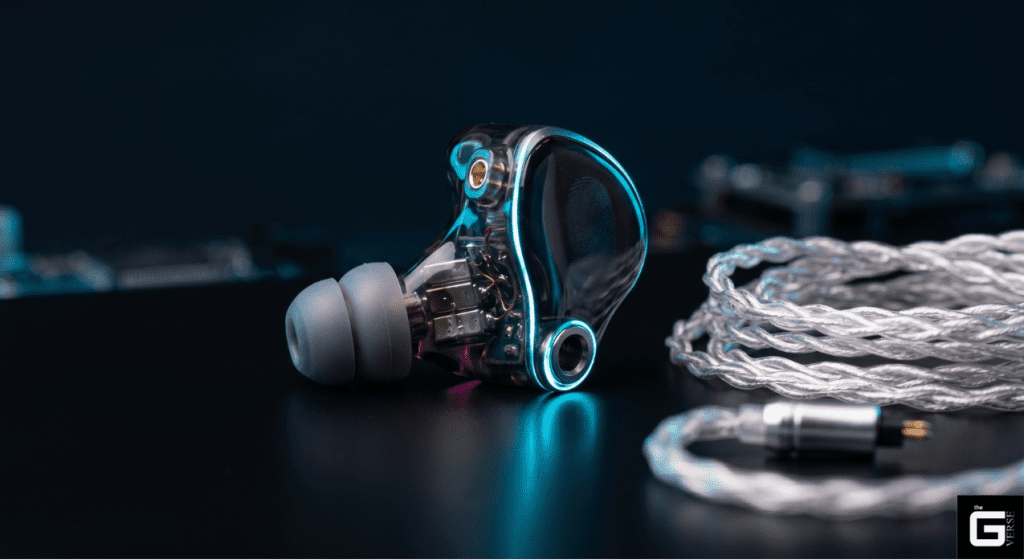
This physical occlusion fundamentally alters the physics of the listening environment. When the ear canal is unoccluded, it acts as a quarter-wavelength resonator with a natural frequency peak around 2.7 kHz to 3 kHz. Once a silicone or acrylic nozzle seals that canal, the acoustic impedance shifts dramatically. The space transitions from an open-ended tube to a closed cavity.
In this closed system, acoustic mass and compliance dictate the frequency response, allowing tiny transducers to generate immense sound pressure levels (SPL) with fractions of a milliwatt. The acoustic impedance looking out of an open ear canal is negligible. But once sealed, the impedance becomes inversely proportional to the volume of the trapped air.
What is In-Ear Monitoring for Musicians?
The genesis of the IEM was born out of sheer necessity on live stages. High stage volume is the ultimate enemy of a clean audio mix.
The Feedback Loop Problem
Before in-ear monitoring became standard practice, singers, audio engineers, and professional musicians relied on wedge monitors. Microphones on a loud stage would inevitably pick up the audio bleeding from these wedges. This created ear-shattering feedback loops that ruined live performances.
Acoustic Isolation
Custom-molded acrylic IEMs provide upwards of -26dB to -30dB of passive noise isolation. This allows the mix engineer to feed a localized, crystal-clear signal directly to the artist without fighting ambient stage noise.
The Drummer Case Study
Field deployments of wireless transmission systems consistently show the highest efficacy with percussionists. A drummer surrounded by cymbals peaking at 115 dBA risks immediate temporary threshold shifts (TTS). By switching a drummer from a 2000-watt drum wedge to custom IEM music monitors, the stage volume drops instantly.
Using modern RF arrays operating on dedicated UHF frequencies, sound engineers can now send a direct, clean monitor mix without acoustic bleed, often bypassing the need for a traditional DI box on stage. The drummer receives a pristine click track and bass feed while simultaneously protecting their hearing from permanent sensorineural damage.
The Science / Research Insight
The physical occlusion of the ear canal modifies the acoustic impedance Z_a. In an open canal, acoustic impedance is negligible at low frequencies. Once sealed, the cavity’s impedance becomes inversely proportional to its volume (Z_cavity = ρc² / jωV). As the volume V decreases due to deep insertion, the pressure P generated for a given volume velocity V_a increases exponentially (P = V_a × Z_a). This allows micro-drivers to produce massive low-frequency amplitude without distortion. Reference: [1]
IEMs vs Earbuds: The Acoustic and Ergonomic Differences
The distinction between IEMs and earbuds is not merely semantic; it is structural. Most consumers ask what is the difference between IEMs and earbuds, assuming it is just a matter of branding. Wrong.
The primary difference lies in the anatomical insertion depth and the resulting ear seal. Earbuds (like classic Apple AirPods or standard flathead designs) sit loosely in the concha bowl. They do not seal the auditory meatus. Without this seal, low-frequency phase cancellation destroys the bass response. Air escapes, and the acoustic pressure required to reproduce sub-bass frequencies dissipates into the surrounding environment.
IEM earphones, however, rely entirely on bridging the gap between the device nozzle and the ear canal walls. This provides immense sound isolation and perfects the sound profile for dedicated music listening rather than casual use.
Clinical sweep frequency tympanogram studies demonstrate exactly how ear canal volume (ECV) interacts with insertion depth. When a transducer is inserted deeper into the canal, the physical volume of trapped air decreases. This reduction in length shifts the natural quarter-wavelength resonance peaks.
A shallow fit might place a harsh resonance spike at 7kHz. Push that same monitor deeper, and the resonance peak shifts safely up to 10kHz or higher, smoothing out the midrange and treble response.
| Anatomical Placement | Sealed within the auditory meatus (ear canal) | Rests loosely in the concha bowl |
| Acoustic Seal | Hermetic (Airtight) | Open / Unsealed |
| Low-Frequency Response | Linear, high-impact sub-bass | Prone to phase cancellation |
| Passive Isolation | High (-15dB to -30dB) | Minimal to None |
| Resonance Peaks | Shifted by insertion depth (7kHz – 10kHz) | Static, often harsh |
What is an IEM Ear Tip? Silicone vs. Foam Acoustics
To understand what an IEM is, you have to understand the interface that connects it to the human body. Finding the right ear tips and experimenting with custom sizes is far more than a comfort accessory for long-term use. It is a highly variable acoustic filter.
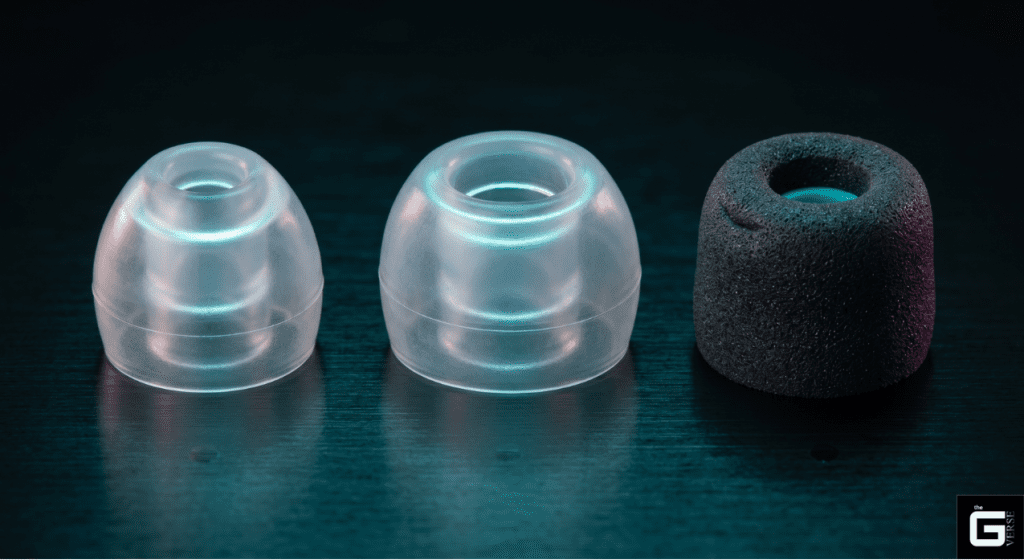
The material density, bore width, and structural rigidity of the tip directly alter the frequency response hitting the eardrum. High-density memory foam ear tips act as a mechanical low-pass filter. As sound waves travel through the nozzle, the porous surface of the foam absorbs high-frequency acoustic energy. Conversely, medical-grade silicone tips feature smooth, reflective inner walls that preserve high-frequency transients and air.
Testing the exact same IEM on an IEC 60318-4 measurement rig reveals striking differences when swapping tips. Foam tips routinely cause a measurable 2dB to 4dB roll-off in the 8kHz region.
If a specific monitor sounds overly bright or fatiguing, switching to foam is a verifiable hardware EQ. If the sound lacks “bite” or transient speed, a wide-bore silicone tip will objectively restore the upper-treble amplitude.
| Standard Silicone | High reflection, preserves transients | 0dB | Reference listening, maximum detail |
| Wide-Bore Silicone | Increases high-frequency resonance | +1dB to +2dB | Taming mid-bass, boosting treble air |
| Memory Foam | High absorption, acts as low-pass filter | -3dB to -4dB | Taming harsh treble, maximizing isolation |
The Science / Research Insight
The geometry of the ear tip bore dictates the Helmholtz resonance of the delivery system. Narrowing the bore diameter increases acoustic mass, which subsequently lowers the resonant frequency, often resulting in an artificially bloated mid-bass. Wide-bore tips reduce acoustic mass, pushing the resonance peak higher into the treble frequencies and preserving the transient attack speed.
Are IEM Headphones Better Than Headphones for Music and Gaming?
The relentless debate over whether IEMs are better than headphones often ignores the physiological mechanics of human hearing. When compared against traditional open-backs or wired gaming headsets, the answer depends entirely on the metric of evaluation: Soundstage versus Imaging.
Open-back headphones excel at Soundstage. They rely on the physical structure of the listener’s outer ear. Sound waves emit from large 50mm dynamic drivers, bounce off the folds of the pinna, and travel down the canal. These micro-reflections provide the brain with spatial cues, creating a wide, holographic sense of depth and verticality.
What are IEMs doing differently? They completely bypass the pinna. They inject sound directly into the ear canal. Consequently, IEMs lack vertical spatial height and grand, out-of-head soundstage. However, they absolutely dominate full-sized headphones in absolute Imaging and transient speed.
Data extracted from competitive tactical shooters (such as CS2 and Valorant) proves this. In these environments, verticality is secondary; horizontal spatial localization is everything. By bypassing the pinna’s natural filtering, which differs wildly from person to person, IEMs deliver raw, unadulterated stereo panning directly to the tympanic membrane.
The result is a hyper-accurate left/right horizontal imaging plane. High-tier competitive gamers frequently refer to this as “wallhack” imaging. The separation between audio cues is so abrupt and distinct that locating an enemy’s exact horizontal vector takes less than 100 milliseconds, delivering unparalleled audio clarity during intense sessions.
The IEM Headset: Fixing White Noise and Static
A massive pain point across audiophile forums and gaming subreddits is the introduction of static or white noise when plugging an IEM headset directly into a computer motherboard.
The issue is strictly electrical. Modern multi-driver IEMs are engineered for extreme efficiency. They frequently possess very low electrical impedance (e.g., 15 ohms or lower) and extremely high sensitivity ratings (often exceeding 115 dB/mW).
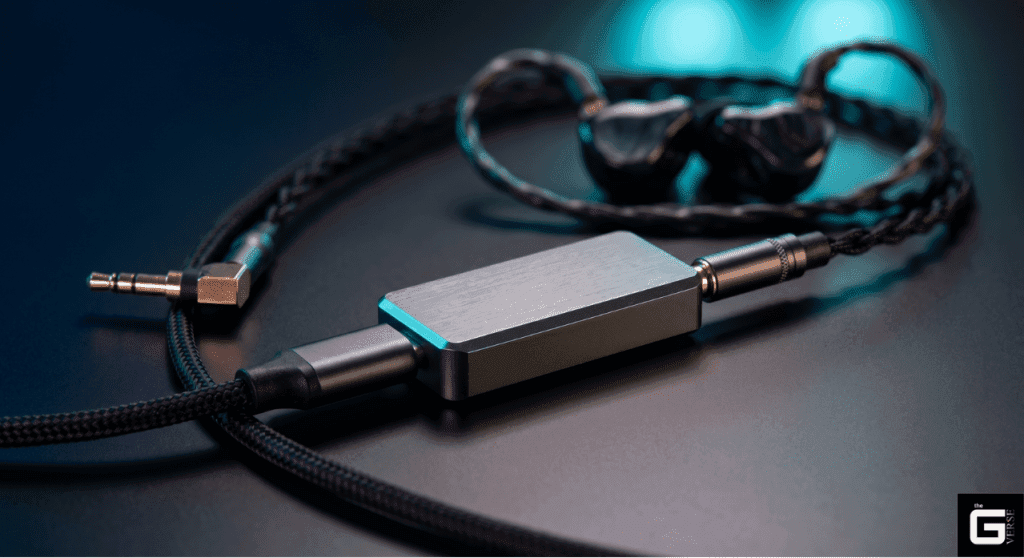
Motherboard audio outputs, even those shielded by “premium” isolated audio traces, are plagued by electromagnetic interference (EMI) from the GPU, CPU, and power supply. Motherboard headphone jacks also often have high output impedance, creating an impedance mismatch that radically skews the IEM’s frequency response.
When a 115 dB/mW monitor is plugged into an unshielded motherboard, it ruthlessly amplifies the microscopic noise floor of the system’s DAC. The result is a constant, maddening white noise hiss.
Steps to Eliminate the Noise Floor:
- Bypass the Motherboard: Stop using the front-panel or rear I/O 3.5mm jacks. The internal EMI environment of a PC case is inherently hostile to sensitive analog audio.
- Deploy a USB Dongle DAC: Utilize an external, low-output-impedance USB DAC (Digital-to-Analog Converter). An external dongle moves the digital-to-analog conversion outside the PC chassis, completely isolating the analog signal from internal EMI.
- Verify Output Impedance: Ensure the external DAC has an output impedance of less than 1 ohm. If the output impedance is too high (e.g., 10 ohms), the voltage division across the IEM’s internal network will aggressively alter the intended tuning, often destroying the bass response.
- Use an Impedance Adapter (Optional): If a new DAC is unavailable, placing a 75-ohm or 100-ohm inline impedance adapter between the IEM and the source will lower the total sensitivity, sinking the noise floor back below the threshold of human audibility.
Do IEMs Have ANC (Active Noise Cancellation)?
Mainstream consumers transitioning from Bluetooth wireless devices like the Nothing Ear (1), Sony LinkBuds, or Beats Studio Buds, used for public transport commutes, frequently ask if IEMs have ANC. While consumer-grade wireless earbuds rely heavily on active noise cancellation, high-end audiophile IEMs actively reject it.
Active noise cancelling operates on the principle of destructive interference. External microphones capture ambient noise, and an internal DSP immediately generates an inverted phase wave to cancel it out. The problem? This environmental noise cancellation introduces latency, audible DSP noise floors, and phase shifts that absolutely butcher micro-detail retrieval.
Audiophile IEMs rely entirely on passive noise isolation. A properly fitted acrylic shell with a triple-flange silicone or high-density foam tip acts as a physical acoustic barricade. Engineering whitepapers routinely show that deep-insertion PNI can achieve up to -30dB of broadband attenuation.
Unlike gym earbuds that rely on ear fins, or alternative formats like bone conduction headsets, IEMs use physical geometry to achieve this isolation. This keeps the audio signal path 100% pure, analog, and phase-coherent.
The Science / Research Insight
The “hiss” experienced with sensitive IEMs is a direct function of the amplifier’s residual noise voltage (V_n). If an IEM has a sensitivity of 115 dB/V, and the source amplifier has a residual noise floor of 10 microvolts (µV), the noise will be distinctly audible. Lowering the sensitivity via an external impedance adapter shifts the amplifier’s noise floor below the listener’s absolute threshold of hearing (ATH), effectively eliminating the static. Reference: [1], [2]
Core Mechanism of IEM Headphones: Drivers and Sound Science
The shell design, internal acoustics, and mechanical topologies determine the capability of the hardware. The industry currently utilizes several core driver technologies across the frequency spectrum.
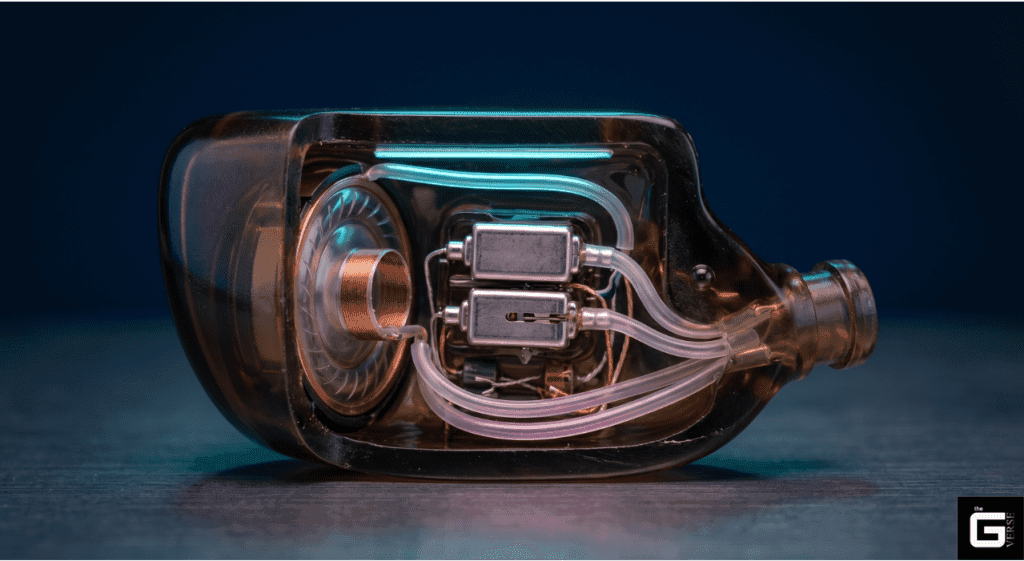
- Dynamic Drivers (DD): The oldest and most common technology. A voice coil attached to a rigid diaphragm sits within a magnetic field. When current passes through the coil, it moves the diaphragm, pushing volumetric air. Dynamic drivers excel at low-frequency reproduction because they move massive amounts of air, generating the physical “slam” required for sub-bass.
- Balanced Armatures (BA): Originally developed by Hugh Knowles for the hearing aid industry in 1955, the BA driver is a marvel of micro-mechanics. Inside a tiny metal enclosure, an armature (a tiny metal reed) is balanced precisely between two magnets. A stationary voice coil surrounds the armature. Current magnetizes the reed, causing it to vibrate. This vibration transfers via a microscopic drive rod to a highly stiff aluminum diaphragm. Because the voice coil is stationary, BAs can be wound with highly specific impedances, making them incredibly efficient. Their transient speed is peerless, making them the absolute gold standard for midrange and treble reproduction.
- Planar Magnetic: A flat, ultra-thin planar driver is suspended between two arrays of magnets. An electrical trace is embedded directly into the diaphragm. When current is applied, the entire surface moves uniformly. Planar magnetic models offer the air-moving capability of a dynamic driver with the transient speed of a balanced armature.
- Electrostatic Drivers (EST): Leveraging a statically charged membrane, EST drivers deliver ethereal, lightning-fast high-frequency extension.
When engineers combine these into hybrid designs, managing the crossover points is make-or-break. The assumption that a higher driver count equates to superior audio is entirely fabricated by marketing departments.
An IEM with 16 poorly implemented drivers will sound objectively worse than a flawlessly tuned single dynamic driver. It is not about the number of transducers; it is about how the acoustic energy is managed through complex crossover networks. Plus, premium monitors feature a detachable cable, utilizing standard A and B pin (0.78mm) or C pin (QDC) connectors to improve longevity.
Multi-Driver Phase Coherence and Crossovers
When multiple transducers are packed into a single shell, the engineering challenge becomes monumental. Sound waves from different drivers must arrive at the eardrum at the exact same millisecond.
If a multi-driver array lacks precision tuning, the waveforms will collide out of phase across the crossover network. This creates massive destructive interference, nulls literal gaps in the frequency response where certain notes simply vanish.
The solution lies in advanced waveguide acoustics. Jerry Harvey (founder of JH Audio) pioneered a patented technology known as FreqPhase. By precisely measuring and cutting the internal acoustic tubing connected to each individual driver, FreqPhase acts as a mechanical acoustic delay.
The high-frequency balanced armature naturally produces sound faster than the low-frequency dynamic driver. By extending the physical length of the high-frequency tube, the high notes are physically delayed just enough so that all frequencies arrive at the tip of the nozzle within 0.01 milliseconds (1/100ms) of each other.
Oscilloscope phase-alignment charts comparing a poorly tuned 5-driver hybrid against perfectly phase-coherent monitors are night and day. A misaligned hybrid will show a jagged, chaotic phase response curve, leading to smeared imaging and unnatural instrument timbre.
A phase-coherent IEM displays a smooth, continuous curve, resulting in pristine audio delivery and linear bass extension. What are IEM headphones without proper crossover alignment? An expensive, disjointed mess. This is exactly why benchmark devices like the Shure SE846 Pro and the Shure SE215 Pro excel where generic models fail.
Pinna Gain and Measurement Standards (711 vs 5128)
To understand what these monitors actually output, you have to look at HRTF (Head-Related Transfer Function). Because an IEM entirely bypasses the human pinna (the outer ear flap), it must artificially recreate the acoustic gain the pinna naturally provides.
Without the pinna, human hearing naturally loses about 10dB to 12dB of volume in the 2.5kHz to 3kHz range. Therefore, a properly tuned IEM must have an artificial 10dB boost at 3kHz to mimic natural ear gain. If this “Pinna Gain” is missing, the audio will sound muffled, dark, and underwater.
For decades, the industry standard for measuring this response was the IEC 60318-4 (commonly referred to as the 711 coupler). It consisted of a simple metal tube housing a microphone. However, the 711 coupler has massive, documented flaws. It consistently produces an artificial, exaggerated resonance spike exactly at 8kHz, completely obscuring the actual upper-treble performance. It also fails to map accurate impedance above 10kHz.
The paradigm has now shifted to the Brüel & Kjær Type 5128 Head and Torso Simulator. The 5128 more accurately models the acoustic input impedance of a living human ear. It features anatomically correct ear canals and soft silicone pinnae.
When testing balanced armature IEMs on the new 5128 rig, researchers discovered a phenomenon known as the “BA Bass Tuck.” Because BAs have a higher acoustic output impedance than dynamic drivers, they are heavily leak-intolerant. They interact differently with the accurate anatomical load of the 5128 compared to the rigid metal tube of the 711. Measurements on the 5128 prove that many highly-rated BA monitors actually lose significant sub-bass impact when placed in a human ear—a metric entirely missed by legacy 711 rigs.
| IEC 60318-4 (711) | Rigid Metal Tube | Poor (Artificial 8kHz Spike) | Overestimates sub-bass |
| B&K Type 5128 | Soft Silicone / Anatomical | Excellent (Accurate to 20kHz) | Highly accurate / reveals roll-off |
The Science / Research Insight
Acoustic phase coherence in multi-driver IEMs is dictated by the equation t = L / c, where t is the acoustic delay, L is the physical length of the waveguide tube, and c is the speed of sound. By varying the physical length L of the acoustic tubing for the tweeter versus the woofer, acoustic engineers can mechanically counteract the differing impulse response times of balanced armatures, ensuring a phase shift discrepancy of less than 1/100th of a millisecond.
Does IEM Damage the Ear? Health Risks and Tympanic Fatigue
The question of whether IEMs damage your ears is paramount for long-term users. Bypassing the outer ear removes the body’s natural biological buffer. The eardrum is subjected directly to raw, unfiltered pneumatic pressure.
Occupational noise exposure limits established by OSHA and NIOSH mandate a maximum safe exposure of 85 dBA as a Time-Weighted Average (TWA) over an 8-hour shift. For every 3 dB increase above 85 dBA, the safe exposure time is cut in half.
Because these monitors seal the canal so efficiently, users frequently underestimate the actual SPL hitting their eardrum, risking permanent noise-induced hearing loss (NIHL). OSHA calculates this mixed exposure using the fraction formula (C1/T1) + (C2/T2) + … > 1 to determine if limits are exceeded.
However, volume is only half the danger. The other hidden hazard is pneumatic pressure. When a traditional dynamic driver pushes air inside a hermetically sealed ear canal, that air has nowhere to go. It strikes the tympanic membrane like a physical piston.
This trapped static air pressure prematurely triggers the Acoustic Reflex (the contraction of the tensor tympani and stapedius muscles). The muscles instinctively contract to stiffen the eardrum, a biological defence mechanism meant to protect the inner ear from loud acoustic trauma.
When the eardrum stiffens, perceived volume drops. The user, thinking the music has gotten quieter, instinctively turns the volume up higher. This creates a devastating cycle of increasing volume and increasing acoustic reflex tension, leading directly to rapid tympanic fatigue.
Preventing Fatigue: ADEL and Apex Pressure Relief
Acoustic engineers recognized the pneumatic pressure flaw and engineered specific mechanical solutions to bleed off the trapped air without sacrificing audio quality. The two most prominent technologies in this space are ADEL (Ambrose Diaphonic Ear Lens) by Asius Technologies, and Apex (Air Pressure Exchange) by 64 Audio.
Stephen Ambrose, the original inventor of the custom in-ear monitor, discovered through clinical trials at Vanderbilt University that sealing the ear canal increased the amplitude of eardrum movement by thousands of times compared to natural listening. To combat this, ADEL technology utilizes an internal membrane that acts as a secondary, sacrificial eardrum.
This microscopic membrane absorbs the pneumatic shockwaves generated by the drivers. Because the pneumatic pressure hits the ADEL membrane instead of the human eardrum, the acoustic reflex is not triggered. The listener perceives the music as vastly louder and more dynamic at significantly lower, safer volume levels.
Following a divergence in corporate vision, 64 Audio developed its proprietary Apex modules. Instead of a membrane, Apex uses pneumatically interactive vents filled with precision-cut, studio-grade multi-cell TPE material. These cylindrical modules are interchangeable and offer different levels of pressure relief and bass attenuation:
- Apex m20 Module: Offers -20dB of ambient noise isolation. Retains the highest amount of low-frequency energy and sub-bass impact while still venting enough pneumatic pressure to prevent deep ear fatigue.
- Apex m15 Module: Offers -15dB of isolation. It features wider dual ambient ports. By releasing pressure more rapidly, the m15 module slightly attenuates the sub-bass (creating a -4dB cut at 20Hz compared to the m20), resulting in a massive expansion of the perceived horizontal soundstage and a cleaner midrange.
- Apex mX Module: Offers only -10dB of isolation. This nearly open-back IEM configuration entirely neutralizes the bass bloat, turning a heavy monitor into an analytical, mastering-grade tool.
Extensive clinical and field testing over brutal 8-hour mixing sessions confirms that deploying the m15 or m20 module entirely eliminates the “underwater” vacuum feeling of standard sealed IEMs. By bleeding off the trapped static pressure, the eardrum remains relaxed in its natural equilibrium, allowing studio professionals and competitive gamers to operate safely for extended durations.
The Science / Research Insight
The Acoustic Reflex (stapedial reflex) is an involuntary muscle contraction occurring in the middle ear in response to high-intensity sound stimuli or excessive pneumatic pressure. By introducing an acoustic vent with a specific flow resistance (such as the Apex m15 module), the DC pressure built up by driver excursion is equalized with ambient atmospheric pressure. This mechanical venting bypasses the reflex trigger, maintaining static tympanic membrane compliance and preventing compression of the perceived dynamic range. Reference: [1], [2]
The Final Verdict: Operational Superiority
Enthusiasts shopping at audio retailers like Concept Kart or DJ City are faced with a saturated market. The mainstream space is currently flooded with generic multi-driver arrays ranging from the ultra-budget Moondrop Space Travel to mid-tier offerings like the Shure Aonic 5, promising impossible audio fidelity via inflated driver counts. Yet, the underlying physics remains undefeated.
Engineering benchmarks like the Shure SE846 Pro or Westone Audio Mach 60 rely on precise crossover execution and hybrid performance tuning rather than pure transducer quantity.
The transition from traditional over-ear headphones to In-Ear Monitors represents an objective upgrade in transient response, horizontal spatial imaging, and absolute noise isolation. A properly phase-aligned, pneumatically vented IEM, paired with an isolated, low-impedance USB DAC signal chain, will comprehensively outperform consumer-grade over-ear hardware.
Frankly, for the audiophile, the touring musician, or the competitive tactician willing to navigate the complexities of acoustic impedance, resonance shifts, and DAC output voltages, the IEM is not just an alternative format. It is the definitive acoustic instrument.