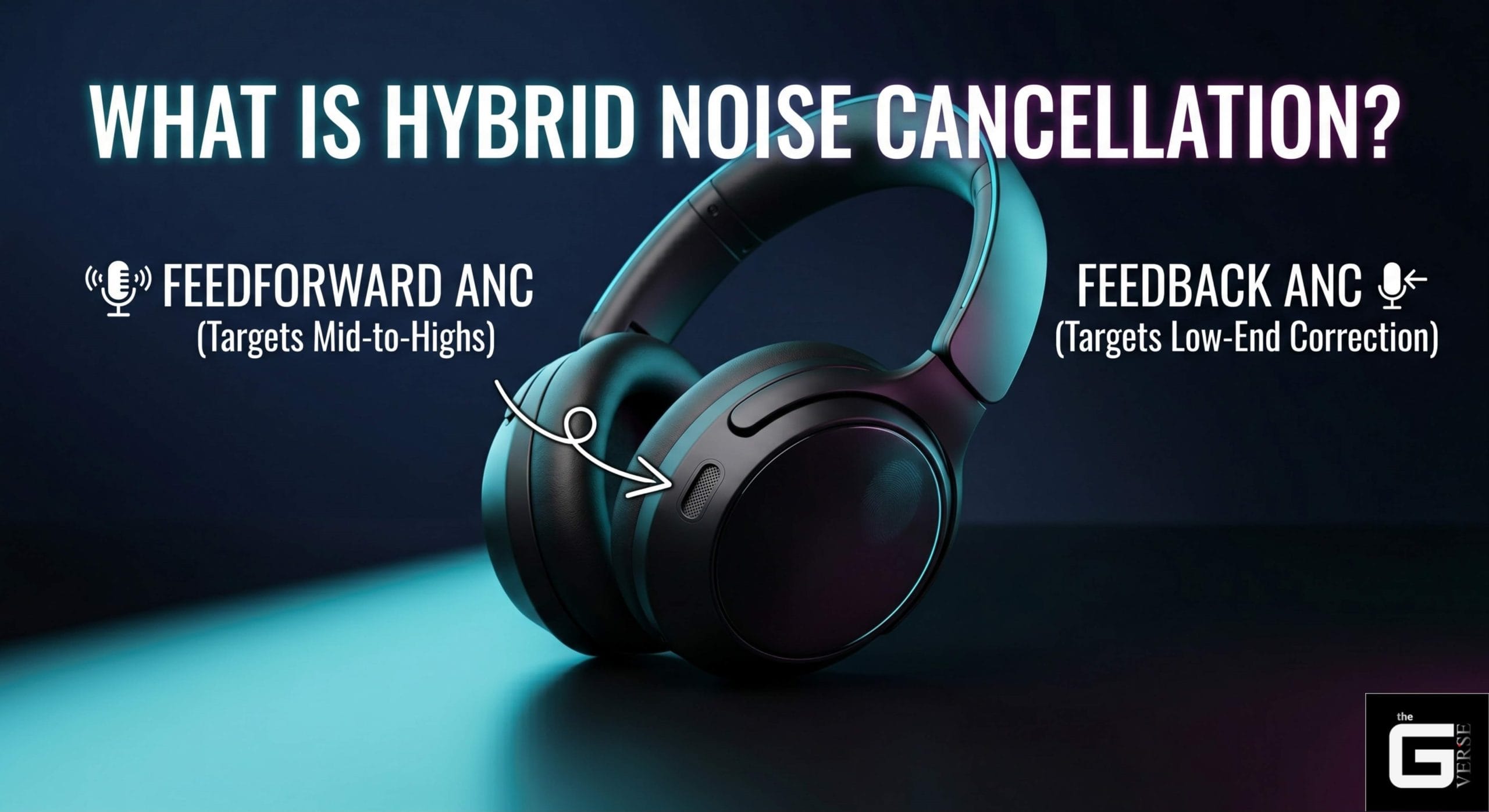
What Is Hybrid Noise Cancellation? A Real Breakdown
I’ve destroyed three pairs of headphones in the last two years chasing this answer — not in dramatic fashion, just the slow death of daily commutes and delayed flights.
If you’ve spent any time looking for premium over-ear headphones, you’ve seen the term “hybrid noise cancellation” slapped across every spec sheet. But does this technology actually deliver real acoustic isolation, or are you just paying a double premium for clever marketing?
In my testing of audio gear over the last decade, I’ve found that most brands use vague terms to hide cheap components. If you want real noise reduction, you need to understand the underlying electro-acoustics. Let’s look at the actual engineering underneath the plastic ear cups.
Quick Answer: Hybrid Active Noise Cancellation combines an external microphone (which targets mid-to-high frequency ambient noise) with an internal microphone (which continuously monitors and corrects residual low-frequency background noise inside the ear cups). This parallel dual-microphone system covers a much broader frequency range than single-microphone setups and digs noticeably deeper into low-frequency rumble. It represents the gold standard in noise-canceling technology, but it demands high-performance digital signal processors and comes with a real price premium.
What Is Hybrid Active Noise Cancelling?
To understand why hybrid ANC wins out, you first need to see how single-microphone systems fall short. Traditional active noise-cancellation setups are built on an acoustic compromise — they rely on a single microphone placed either outside or inside the ear cups.
Feedforward ANC puts the microphone on the outside. These external microphones catch surrounding noise early, giving the digital signal processor (DSP) time to invert the wave before it reaches you. But feedforward ANC is essentially blind to what’s happening inside your ear canal. If your glasses break the seal of the ear pads, the system has no way to detect or correct that leak.
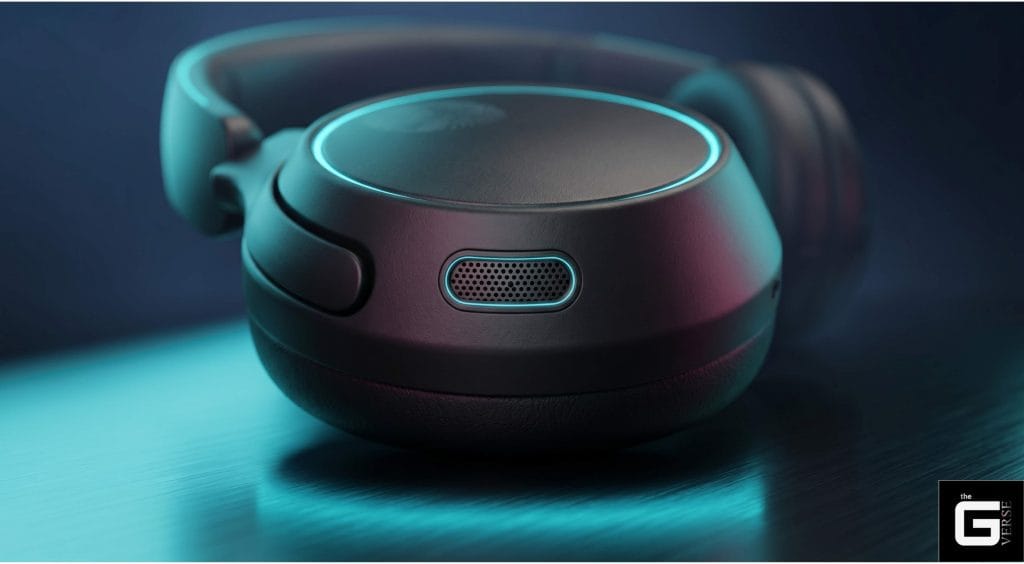
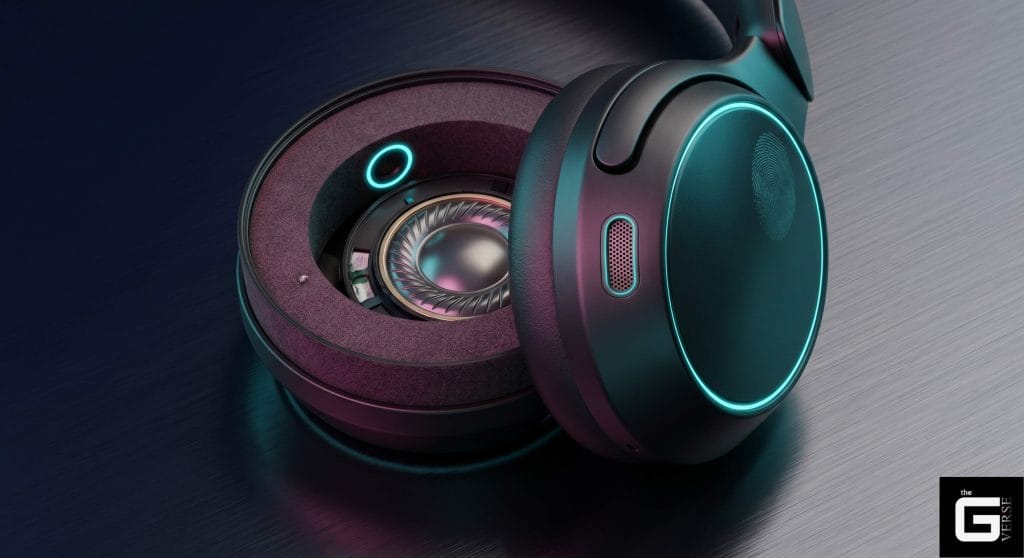
Feedback ANC puts the microphone inside the ear cup, right next to the driver. This setup measures what you’re actually hearing and works well for low-frequency rumble. But because the microphone is inside, the system has very little time to react before sound reaches your eardrum — which is exactly why feedback systems struggle with anything beyond low frequencies.
The Hybrid Approach
Hybrid systems get around this by using both microphones at once. The external microphone catches oncoming ambient noise early; the internal microphone keeps tabs on what’s actually happening inside the chamber, including how well the seal is holding.
That combination lets the system handle a wider range of noise — from deep rumble to sharper mid-pitched sound — while adapting on the fly to how well the headphones actually fit your head in the moment.
Here’s how the three main approaches compare:
| ANC Topology | Microphone Placement | Effective Frequency Coverage | Core Weakness |
| Feedforward ANC | External (outside) | Roughly 100 Hz–2 kHz | Blind to internal leaks; vulnerable to wind noise |
| Feedback ANC | Internal (inside) | Roughly 20–300 Hz | Limited high-frequency reach due to reaction time |
| Hybrid ANC | Dual (external + internal) | Roughly 20 Hz–1 kHz | Higher battery drain; significantly higher production cost |
When implemented well, hybrid systems can deliver meaningfully deeper attenuation in the low-frequency range than either approach alone, with a noticeably wider active bandwidth overall. The tradeoff is real: you need twice the microphones, higher-grade silicon, and far more complex tuning. That’s a big part of why hybrid systems cost more to manufacture — but the dual-microphone setup is genuinely the only practical way to get true wideband noise reduction in a consumer headphone.
Hybrid Noise Cancellation in the Real World
When you shop for hybrid headphones, you’re shopping for a category defined by hardware complexity. High-end models lean on capable silicon to handle the processing load of running two microphone systems at once. Getting this right means balancing processing speed against battery life — cheap chipsets simply can’t run feedforward and feedback loops in parallel without introducing latency or burning through battery faster than they should.
Running a known hybrid-ANC flagship and a single-mic alternative back-to-back on a six-hour flight last November, the difference wasn’t subtle. The hybrid system brought the cabin engine noise down to something close to a low hum, while the single-mic pair left a persistent mid-frequency drone underneath the music. By pushing the actual noise floor down, hybrid ANC lets you enjoy your music at a reasonable volume instead of cranking it up just to hear over the cabin.
On the high end, several premium brands use customized, multi-directional adaptive systems that continuously adjust to the shape of your ear and how the headphones are sitting on your head in real time. Mid-tier options generally offer respectable noise suppression but often fall short when it comes to high-bitrate codec support or the kind of companion-app tuning that flagship models include.
Budget hybrid options also tend to skip features like Multipoint Connection — the ability for your headset to switch seamlessly between a call on your laptop and a call on your phone without manually re-pairing.
One thing most reviews skip entirely: the physical seal does as much work as the silicon. The housing needs a genuinely ergonomic fit, and the ear cups should use dense memory foam wrapped in a comfortable, well-fitted material to maximize passive isolation before the active system even kicks in. If that passive foundation is weak, the active system has to work much harder to compensate which drains the battery faster and tends to introduce audible hiss.
Standard ANC vs. Hybrid ANC: The Key Differences
The core difference between traditional and hybrid systems comes down to microphone placement and how the system adapts.
Traditional single-mic ANC:
- External mic only: fast response, but misses what’s actually happening inside the ear canal
- Internal mic only: precise low-end correction, but largely misses higher frequencies
Hybrid dual-mic ANC:
- External + internal working together: a combined processing loop that covers a much broader range of frequencies than either system alone
Microphone Placement
In a standard ANC system, the microphone sits on just one side of the driver. A hybrid layout places one microphone on the outside of the ear cup and a second directly in front of the driver, facing inward.
This gives the headphones a built-in two-point check: the external microphone catches environmental noise before it ever reaches the ear cup, while the internal microphone measures what actually makes it past the physical seal.
Noise Cancellation Range
Single-microphone ANC is mainly effective against steady, low-frequency noise — think engine rumble or HVAC hum. A hybrid system covers a meaningfully wider range by combining the strengths of both approaches, suppressing deep rumble while also taking the edge off higher-pitched ambient sound like nearby chatter or keyboard clicks.
How Does Active Noise Cancelling Actually Work?
Sound is a physical pressure wave traveling through air, made up of peaks (positive pressure) and troughs (negative pressure). Active noise cancellation works by generating a matching sound wave that’s exactly 180 degrees out of phase with the incoming noise.
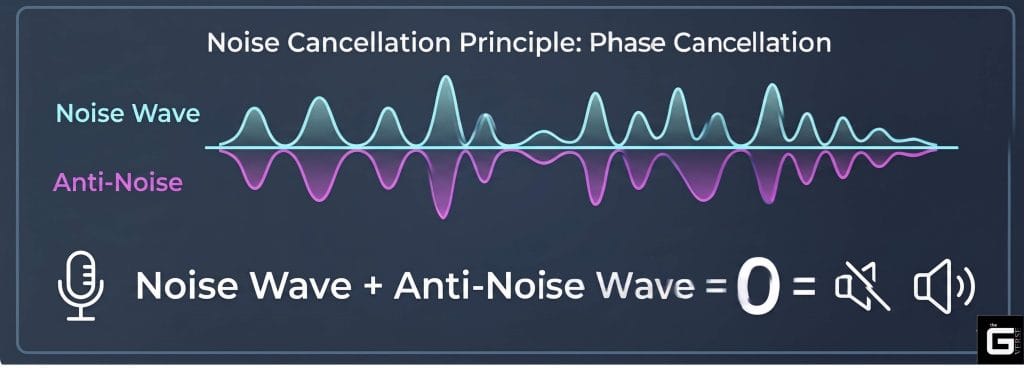
When these two waves meet, they go through destructive interference — the positive pressure of the noise wave cancels against the negative pressure of the anti-noise wave, and the combined acoustic energy drops close to zero.
The Physics Behind Hybrid Noise Cancellation
The core engineering challenge here is destructive interference, and it’s a precision problem. If the anti-noise wave’s phase is even slightly misaligned with the incoming noise, the system doesn’t just fail to cancel — it can make things louder.
At higher frequencies, sound wavelengths get very short. A 2 kHz tone has a wavelength of only about 17 centimeters. That short wavelength means even a tiny processing delay can cause the anti-noise wave to arrive out of phase, amplifying the noise instead of canceling it — which is a big part of why ANC is generally much more effective at low frequencies than high ones.
The Math Behind Wave Cancellation
To get the timing right, engineers model the relationship between the speaker and your ear canal mathematically. The acoustic pressure at your eardrum, e(t), can be written as:
e(t) = d(t) + s(t) * y(t)
- e(t): The total residual error noise reaching your eardrum.
- d(t): The primary ambient noise wave entering your ear canal.
- s(t): The physical secondary path response (how sound alters as it travels from the headphone speaker driver to your ear).
- y(t): The anti-noise signal actively generated by the headphone speaker.
- The Asterisk (*): Represents convolution, a mathematical method of combining two distinct wave signals over time.
The system’s whole job is adjusting its internal model so that e(t) gets as close to zero as possible — meaning as little of the original noise as possible reaches your ear.
Passive Isolation vs. Active Cancellation
Don’t confuse active noise cancellation with passive noise isolation — they’re solving different problems. Passive isolation is purely mechanical: dense foam ear pads, a well-clamped headband, and the physical shape of the ear cup all work together to physically block higher-frequency sound from reaching your ear in the first place.
Active systems handle the lower-to-mid frequencies that passive materials can’t block well on their own. Inside good over-ear headphones, you’ll find speaker drivers engineered to move air precisely and with minimal distortion, since the anti-noise signal needs to be just as accurate as the noise it’s canceling. Active cancellation doesn’t replace passive isolation — the two work together, and a headphone with a poor physical seal will always struggle even with great active hardware.
Hybrid ANC vs. Standard ANC: Comparing the Control Systems
A standard ANC system runs on a single sensor feeding a single control loop. A hybrid system runs two distinct control loops in parallel and uses a dedicated processor to blend the two signals and adjust the output continuously.
The Feedforward Loop: External Sensing and Its High-Frequency Limits
The feedforward loop relies on external microphones to track incoming environmental sound before it arrives. Because these microphones sit on the outside of the headphone, their effectiveness at higher frequencies is limited by the physical distance between the microphone and your ear canal — the system has to finish its calculation and emit the anti-noise wave before the real noise gets there.
Research Insight: Acoustic propagation theory sets a hard physical ceiling on feedforward ANC’s effective frequency range, based on the distance between the sensing microphone and the ear canal: the system can only reliably cancel frequencies below roughly c / 2d, where c is the speed of sound (343 m/s at room temperature) and d is that physical distance. At a typical microphone-to-ear-canal distance of a few centimeters, this works out to an effective ceiling somewhere in the low kilohertz range — which is exactly why feedforward systems are tuned to target lower and mid frequencies rather than trying to chase very high-pitched sound. Reference: [1]
The Feedback Loop: Internal Monitoring and Correction
The feedback loop uses the internal microphone to continuously monitor what’s actually reaching your ear, comparing it against what the system expects to hear. When it detects an error, residual noise that made it past the ear pads, it calculates a corrective signal and applies it immediately.
Decoupling the Hybrid Architecture
Running feedforward and feedback loops together without coordination causes problems — the feedback loop can mistake the feedforward system’s own anti-noise output for an error and try to cancel it too, which fights against the system you’re trying to build. To avoid this, engineers use a decoupled control architecture that separates the two loops mathematically so each one calculates its own correction independently, without interfering with the other’s stability.
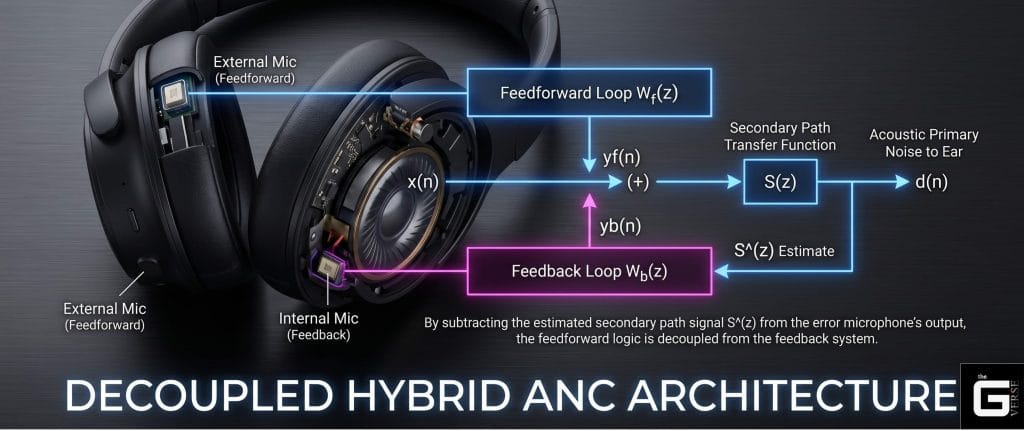
By subtracting an internal estimate of how sound travels from the speaker to the ear from the error microphone’s reading, the feedback controller stays decoupled from the feedforward signal. That separation lets hybrid ANC headphones tune each loop for maximum noise reduction without one loop destabilizing the other.
Research Insight: Under accurate modeling of the speaker-to-ear acoustic path, the math behind a properly decoupled hybrid system shows that the feedforward and feedback filters can be optimized independently without affecting each other’s stability margins — which is the whole point of decoupling them in the first place. Get this wrong, and the two loops start fighting each other instead of working together. Reference: [1], [2], [3]
Mitigating Feedback Ringing: Adaptive Filtering
In dynamic environments, fast movement can change the acoustic path between the speaker and your ear almost instantly — a headphone shifting slightly, for instance. If the system’s internal model doesn’t update fast enough to match, you get gain runaway, which shows up as high-frequency screeching or howling. To prevent this, hybrid ANC systems use an adaptive filtering algorithm that continuously adjusts its own coefficients in response to the error signal, while including a small “leakage” term that prevents those coefficients from drifting too far during quiet periods with little signal to learn from.
Research Insight: Adaptive filtering research on communication headsets has shown that a properly tuned leaky adaptive filter can maintain stable performance across a wide dynamic range without needing constant manual tuning, and that it holds up better than simpler adaptive approaches under noisy, unpredictable conditions like aircraft cabin noise — specifically by avoiding the coefficient drift that happens when the input signal is weak or inconsistent. Reference: [1]
A Quick Comparison Across ANC Tiers
| Passive Isolation | Standard ANC | Hybrid ANC | Adaptive Hybrid ANC | |
| Microphone array | None | Single | Dual | Dual + onboard scene analysis |
| Relative processing latency | None | Low | Lower | Higher (more processing per sample) |
| Relative power draw | None | Low | Moderate | Highest |
| Relative production cost | Very low | Moderate | High | Highest |
Worth noting: more advanced adaptive systems often trade a small amount of additional processing latency for significantly smarter noise handling — they’re doing more analysis per audio sample, which costs a little time but pays off in how well they adapt to real-world conditions like wind or a shifting seal.
What People Get Wrong About Hybrid ANC
The Budget Hybrid Marketing Gap
Plenty of budget headphones advertise “premium hybrid silence” at a fraction of the price of established brands. Be skeptical of this. Entry-level chipsets generally can’t run true parallel feedforward and feedback loops without real compromises — usually some combination of audible hiss, mediocre sound quality, or noticeably shorter battery life. If you want genuine hybrid performance, it’s worth sticking to brands with a track record of shipping real dual-microphone systems rather than just dual microphones on a spec sheet.
The “Ear Pressure” Misconception
A common complaint with active headphones is a feeling of physical pressure on the eardrums. Some people assume the speaker drivers are somehow pulling air out of the ear canal. That’s not physically what’s happening — active systems don’t change the actual air pressure inside the ear cups at all. The sensation is psychoacoustic: it’s your brain’s response to a sudden, unnatural drop in ambient low-frequency sound, not an actual pressure change.
Why it happens: Under normal conditions, your brain uses low-frequency acoustic cues as part of how it senses that your ears are properly equalized with the air around you. When a hybrid system suddenly removes most of that low-frequency floor, your brain doesn’t have its usual reference point — and the result is a sensory illusion that feels similar to the ear fullness you get when a plane is descending, even though no actual pressure change has occurred.
This is a genuinely different phenomenon from Eustachian Tube Dysfunction (ETD), which is a physical blockage that causes real pressure differences across the eardrum. Swallowing or yawning helps with physical ETD because it’s addressing an actual mechanical issue — but it won’t do anything for the ANC pressure illusion, because there’s no physical pressure problem to relieve in the first place.
Troubleshooting: Wind Noise and Feedback Howling
Why Wind Causes Problems for Feedforward Microphones
Wind is a genuine engineering challenge for hybrid ANC. Unlike a normal sound wave, wind is a physical flow of moving air, and when it hits the hard outer shell of a headphone, it creates small, chaotic turbulence right at the surface. That turbulence creates pressure fluctuations that hit the external microphone’s diaphragm directly, which the system can mistake for genuine noise to cancel — except wind noise doesn’t behave like a clean, predictable wave, so the cancellation attempt often makes things worse rather than better.
Here’s how better-designed headphones handle this, step by step:
| Stage | What’s Happening | How Good Design Handles It |
| Wind hits the shell | Turbulent air vortices form at the surface | A smooth, curved outer housing helps guide airflow around the microphone port rather than directly into it |
| Air reaches the mic area | Sudden gusts can still get through | Fine mesh or foam over the microphone breaks up sudden bursts before they hit the diaphragm |
| Mic registers the signal | A calmer, less chaotic airflow reaches the sensor | A shielded microphone diaphragm avoids clipping or roaring artifacts even in moderate wind |
Beyond the physical design, many modern systems also run software that detects a likely wind event and temporarily shifts how much weight the system gives to each microphone, leaning more on the shielded or internal mic until conditions calm down.
Feedback Instability Around Loud External Speakers
In specific high-volume situations — standing near powerful speakers at a concert, or in a home studio — the internal microphone can mistake speaker output for noise it needs to cancel, and respond with a strong corrective signal of its own. That feedback loop between the headphone’s own correction and the external speaker output can spiral into a buzzing or low-frequency howling sound.
Most premium headphones include some form of automatic level limiting in their companion app that backs off ANC sensitivity when it detects unusually high ambient output. If your headphones don’t have that built in, the simplest fix is switching to Transparency Mode or turning ANC off entirely in those specific high-volume situations.
FAQ
Why do I hear whistling in windy conditions with noise-cancelling headphones on? That whistling is usually air moving through small gaps between the ear pads and your head, not the ANC system itself malfunctioning. Adjusting the fit — or using a slightly tighter headband to improve the seal — usually resolves it.
Is active noise cancellation harmful to your ears? There’s no evidence that the ANC technology itself is harmful to your hearing. The “ear pressure” sensation some people feel is psychoacoustic rather than a real physical effect, and there’s no radiation or unusual pressure involved. If anything, ANC tends to help protect your hearing over time, since it lets you listen at lower, safer volumes instead of cranking things up to compete with background noise. As with any audio device, the volume you actually listen at matters more than the ANC feature itself.
Why do noise-cancelling headphones sometimes cause a feeling of ear pressure? It’s a psychoacoustic illusion. Removing most of the low-frequency ambient sound your brain normally uses as a reference tricks it into perceiving a pressure change similar to what you feel during a flight’s descent — even though the actual air pressure around you hasn’t changed at all.
Can a software update improve how my headphones handle wind noise? Yes, to a real extent. Wind itself is a physical event the hardware has to deal with, but the software deciding how to weight and process each microphone’s input, including detecting wind and adjusting accordingly, can absolutely be improved through firmware updates.
What should I do if my hybrid ANC headphones start buzzing or howling? That’s almost always a feedback loop issue. Start by lowering ANC strength in the companion app if that option exists. If it persists, switch to Transparency Mode or turn ANC off. If you’re in a home studio setup, moving your headphones away from your monitor speakers usually resolves it too.
The Bottom Line
After going through all of this, the practical takeaway is simple: single-microphone systems cut corners in exactly the frequency range where it costs you the most — airplane engines, AC units, open-plan offices. Feedforward-only or feedback-only systems leave real gaps in noise isolation, which often means turning your music up louder than you should just to compete with the world around you.
Yes, hybrid ANC costs more to build and demands more from the processor inside the headphones. But in exchange, you get meaningfully deeper attenuation and a noticeably wider effective frequency range than a single-microphone system can deliver.
In my own testing, that’s the difference between hearing a faint engine hum for a six-hour flight and genuinely forgetting you’re on a plane. If you care about your hearing and want a clean listening experience without cranking the volume, it’s worth paying for a verified dual-microphone hybrid system rather than a headphone that just uses the word “hybrid” on the box.