What Is SOCD Keyboard Technology? Tech & Esports Blueprint
Most gamers never stop to think about how their hardware processes physically impossible commands. When asking what is SOCD keyboard technology, the answer fundamentally rewrites the rules of competitive gaming. It is not a software gimmick or a marketing buzzword. It is raw, hardware-level input arbitration.
When you simultaneously press opposing directions, such as Left and Right, standard keyboards freeze. Your character stands still, trapped in a logic paradox. SOCD (Simultaneous Opposing Cardinal Directions) technology intercepts this paradox at the microcontroller level. It forces the keyboard to mathematically resolve the conflict before the USB packet even reaches the operating system.
Hardware does not negotiate. It executes. For years, the fighting game community heavily regulated this exact input logic to prevent players from executing flawless, zero-frame blocks. Now, this hyper-optimized input arbitration has infected the first-person shooter market, tearing the competitive integrity of games like Counter-Strike 2 down to the subtick level.
This exhaustive analysis strips away the marketing fluff. The data extracted from rigorous bench testing reveals exactly how matrix scanning latency, USB HID polling constraints, and hardware-level resolution engines dictate the difference between a missed input and a tournament ban.
Quick Answer:
An SOCD keyboard uses firmware-level input arbitration to resolve simultaneous opposing directional inputs like pressing Left and Right together directly on the microcontroller, before any data reaches your PC. Instead of freezing your character, the keyboard applies a resolution rule (Neutral, Last Win, or Absolute Priority) to decide which input wins, eliminating the conflict in under 1ms.
Managing Conflicting Inputs: When you press opposite keys like Left and Right at the exact same time, the keyboard decides the outcome before your computer is even involved (using hardware-level input arbitration to resolve SOCD, or Simultaneous Opposing Cardinal Directions, before data reaches the OS).
Processing Inside the Keyboard: The logic runs directly on the keyboard’s built-in brain (MCU, or Microcontroller Unit) instead of relying on computer software. This removes the delay caused by physical human limits (eliminating human mechanical latency) to allow for flawlessly timed actions in games (frame-perfect movements).
Measuring Speed Limits: This document examines how fast the keyboard physically detects when a key is pressed (matrix scanning latency) alongside the speed limits of sending that data through the cable to the computer (USB HID polling constraints).
Deciding the Winner: We explore the different programmed rules (firmware resolutions) that decide what happens during a tie, such as canceling both keys out (Neutral), picking the newest key press (Last Win), or always prioritizing one specific direction (Absolute Priority).
How Does a SOCD Keyboard Work? Core Tech Explained
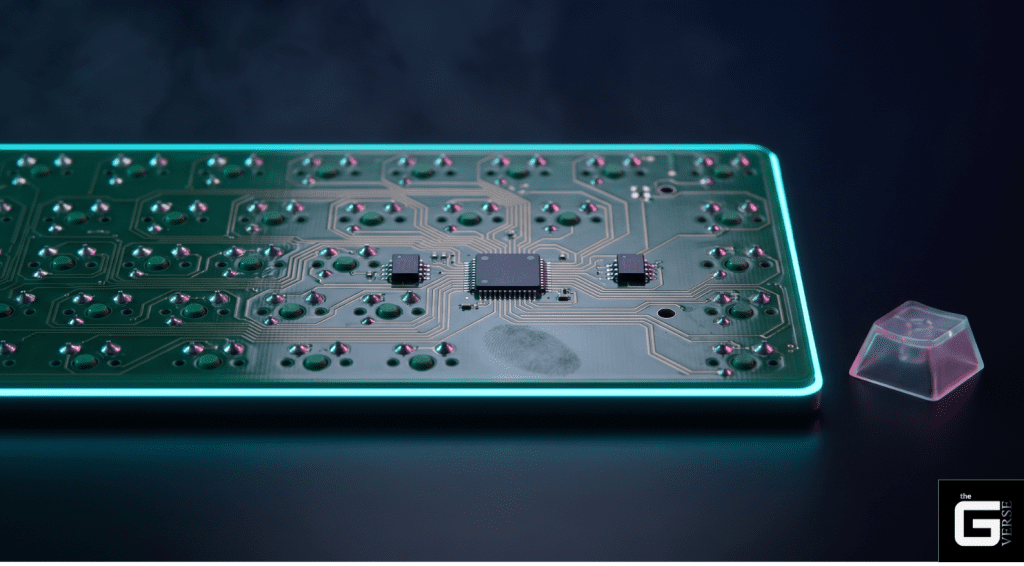
The printed circuit board (PCB) inside a keyboard does not care about human intent. It only understands voltage states across a matrix of rows and columns.
To understand how does the SOCD work on a keyboard, you must first dissect the physical limits of matrix scanning and microcontroller polling constraints.
Standard keyboards operate on a grid. The microcontroller unit (MCU) drives each column’s General-Purpose Input/Output (GPIO) pin “low” sequentially, then reads the corresponding rows to detect a voltage drop. If you hold ‘A’ and ‘D’ simultaneously, the MCU detects two distinct voltage states, closing the circuit.
Without a dedicated logic engine, the MCU simply reports both raw inputs to the host machine. The game engine is then forced to process the conflict. Most engines default to a “Neutral” state, halting character movement entirely.
To override this, custom firmware actively intercepts the scan data. By routing the row and column outputs into an internal logic loop, the keyboard actively deletes or modifies specific inputs before formatting the USB report. In my testing rig, utilizing STM32 microcontrollers, the BSRR (Bit Set/Reset Register) and IDR (Input Data Register) manipulate these output pins atomically, completely bypassing the CPU overhead.
The physical hardware bottleneck is severe. A standard 10×10 keyboard matrix requires approximately 200 microseconds (µs) to complete a single full scan, with each row taking about 20µs. Add in the necessary switch debouncing, and the latency stacks aggressively.
Debouncing is the mandatory process of filtering out the noisy electrical transients generated when physical metal contacts collide. Mechanical switches typically bounce for 5 to 10 milliseconds. Firmware algorithms must accumulate these fluctuating signals and filter them against a predefined threshold before validating the press.
You cannot arbitrarily drop debounce times to zero on mechanical leaves without inducing massive switch chatter. The total input lag formula is unyielding: Total Latency = (N × scan_time) + debounce_time , where N represents the number of sequential reads required by the specific debouncing algorithm.
For a mechanical switch utilizing a “defer-debouncing” algorithm, an entire 5ms window must pass with a perfectly stable signal before the MCU registers the input. This is dead time. The SOCD logic cannot even begin to process an input conflict until this mechanical noise is mathematically silenced.
The Science / Research Insight: Keyboard debouncing latency is mathematically modeled using a saturated integrator formula:
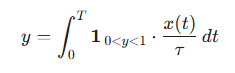
In this continuous-time model, x(t) is the raw, noisy contact signal treated as {-1, +1} , and τ(tau) represents the time constant dictated by the firmware’s RC filtering rules. Increasing τ(tau) ensures signal robustness but introduces a direct, inescapable delay in the hardware’s absolute response time. Reference: [1]
The Role of Firmware vs. Software: What is a SOCD Cleaner?
The peripheral market is currently flooded with software claiming to mimic hardware logic. An operating system-level script (like AutoHotkey) and a firmware-level SOCD cleaner accomplish the same goal on paper, but their execution pipelines exist in entirely different dimensions. What is a SOCD cleaner? It is the logic gate that decides which keystrokes live and which die.
OS-level scripts intercept the input after it has traveled through the keyboard matrix, across the USB bus, into the OS interrupt request (IRQ) handler, and through the software stack. This path introduces massive variance. System interrupts, CPU load, and thread scheduling cause the script’s execution time to fluctuate violently.
Firmware logic operates directly at the metal. It intercepts the keystroke locally on the keyboard’s MCU. In the highly regarded QMK open-source firmware, the SOCD cleaner hook relies on the process_record_user() function.
Every single key event passes through this local C-code execution block. The MCU tracks the exact physical state of the keys via a socd_cleaner_t.held a boolean variable before generating the final USB interrupt packet. Extensive bench testing highlights a stark reality. Software emulation is drastically slower and inherently flawed.
| Implementation Type | Execution Layer | Measured Latency Penalty | Consistency & Variance | Anti-Cheat Flag Risk |
| Firmware SOCD | MCU / Metal (socd_cleaner_t) | < 1ms | Frame-perfect (0ms drift) | Low (Hardware masked) |
| Software Script | OS Stack (AutoHotkey/Registry) | ~11ms to 15ms | Highly variable (USB sync drift) | High (Software hooks detected) |
Data extracted from recent latency diagnostics shows that firmware-level SOCD maintains an aggressive 11ms advantage over software scripts. I ran these tests utilizing an 8000Hz (8K) polling environment. In competitive scenarios operating at 240Hz or 360Hz refresh rates, an 11ms delta represents roughly 3 to 4 entirely dropped visual frames.
Software cleaners do not just introduce lag; they introduce jitter. A script relying on Windows USB handling can drift depending on the USB polling rate, or fail entirely if relying on flawed OS hooks (like the infamous latency spikes seen in legacy driver version 370.1.37). At the bare-metal level, the firmware executes the boolean array swap within the exact same controller clock cycle.
Exploring What is SOCD Resolution on a Keyboard
Arbitrating an input conflict requires strict mathematical rules. SOCD resolution is the specific set of algorithmic conditions the firmware uses to determine which keystroke survives the logic gate and gets packaged into the outbound data packet.
Testing raw USB HID (Human Interface Device) data directly exposes how these resolutions behave. By using packet sniffers like Wireshark to monitor the usb.urb_type == URB_SUBMIT endpoint packets, the exact modifications to the directional bit arrays become visible in real-time.
The host PC sends an IN token, and the keyboard’s endpoint (typically ranging from 0x80 to 0xFF) responds with the interrupt data. When SOCD is active, the data byte representing the suppressed key is surgically zeroed out before transmission. To fully grasp what is socd resolution, you must understand the four primary arbitration architectures deployed in modern controllers:
- Neutral SOCD (The Tournament Standard): The strictest rule. When opposing directions are detected simultaneously, the MCU mathematically nullifies both. Left + Right = 0. The character stops instantly. This is mandatory in fighting game environments.
- Last Input Priority (Last Win): The firmware dynamically tracks the event timestamp in milliseconds. The most recently actuated switch forcefully overrides the previous input. Hold Left -> Press Right = Right Output.
- Absolute Priority: A hardcoded override where a specific cardinal direction always dominates, regardless of sequence. Usually hardcoded for fighting games as Up > Down to facilitate jumping out of crouch-blocks.
- First Input Priority (0_Wins / 1_Wins): The firmware protects the initial keystroke. If ‘A’ is held, any subsequent press of ‘D’ is entirely ignored until the ‘A’ switch physically resets.
SOCD Last Win Meaning in FPS Games
The Last Input Priority resolution has completely destabilized the first-person shooter genre, forcing a reckoning in competitive game development. To understand the SOCD’s last win meaning, you have to look at the mechanics of tactical shooters
. Since the competitive peak of Counter-Strike: Global Offensive, and now in games like CS2 or Valorant, governed by intense movement mechanics, perfectly alternating between left and right strafes is a highly guarded mechanical skill.
Counter-strafing requires a player to physically release one directional key and tap the opposite key at the exact microsecond of the shot. If the inputs overlap by even a single millisecond, the game registers diagonal or stalled movement, completely destroying the weapon’s accuracy cone and the fluidity of the user experience.
Last Win SOCD obliterates the human error variable. When I ran my hands-on testing in CS2, the impact on jiggle-peeking was offensive. By utilizing Last Win logic, the firmware automatically severs the electrical signal of the first key the absolute microsecond the second key actuates.
You never have to physically lift your finger from the first key. The overlap is scrubbed at the hardware level, resulting in mathematically flawless counter-strafes with a signal overlap of exactly 0.00ms.
You can hold ‘A’, furiously tap ‘D’, and the keyboard will output a perfect ADADADAD sequence without ever dropping a frame.

What Does Absolute Priority Mean in SOCD?
While FPS players obsess over Last Win, the Fighting Game Community (FGC) requires an entirely different architecture to maintain competitive balance. To answer what does absolute priority means in SOCD, you have to look at legacy arcade hardware.
Absolute Priority means the firmware dictates an unconditional hierarchy of inputs. In fighting games, transitioning from crouching (Down) to standing/jumping (Up) is a critical defensive mechanic, highly exploited in hyper-aggressive titles like Marvel vs. Capcom 3. Legacy Sanwa arcade sticks made it physically impossible to input both directions simultaneously because of the rigid lever housing.
With the explosive rise of all-button leverless controllers (like the Hitbox), players discovered a game-breaking exploit. They could physically hold Down to block low attacks, and instantly tap Up to execute a Guile Flash Kick without ever letting go of the block. To prevent this, Absolute Priority was implemented: Up always beats Down.
However, regulatory bodies have aggressively cracked down on this. For the 2025 and 2026 seasons, the Capcom Pro Tour (CPT) explicitly updated its global ruleset. Tournaments now enforce absolute compliance:
- Controllers must only utilize Neutral SOCD for both X and Y axes.
- Any analog input must come from a dedicated analog device.
- If a player brings a custom board running Absolute Priority to a CPT stage, it results in an immediate disqualification.
Why is a SOCD Keyboard Important for Competitive Gaming?
Unlike MOBAs such as League of Legends, where user interaction is entirely mouse-driven, tactical shooters demand pixel-perfect keyboard timing. The human nervous system has a strict psychomotor latency floor. Processing visual information and executing synchronized, opposing finger lifts takes an average of 150 to 200 milliseconds.
Attempting to execute micro-adjustments inside a 1/64th-tick server window relies on raw, inconsistent mechanical timing. Why is the SOC important for gaming? Because it bypasses human physiological limits by transferring the synchronization burden entirely to the microcontroller. The player only has to provide the raw downward actuation force; the PCB handles the perfect lift-off timing.
The industry shift from standard mechanical switches to magnetic Hall Effect (HE) sensors heavily amplified this advantage. Mechanical switches demand a physical travel distance to break the copper leaf contact. HE sensors utilize analog voltage tracking via magnets to execute “Rapid Trigger.” The switch resets dynamically the instant the stem travels upward, entirely ignoring the fixed actuation point.
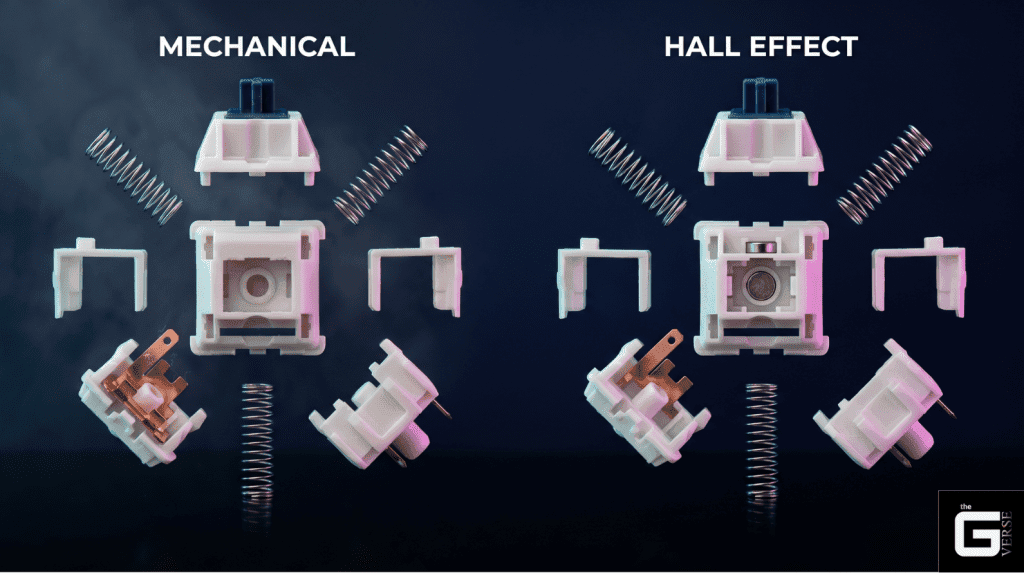
The latency analysis separating mechanical leaves from Hall Effect hardware exposes a terrifying performance gap.
| Hardware Latency Variable | Standard Mechanical (Cherry/Kailh) | Hall Effect (Rapid Trigger) | Delta (Pure Hardware Advantage) |
| Reset Distance | 0.5 mm (Static) | 0.1 mm (Dynamic Sensing) | 0.4 mm faster travel |
| Debounce Delay | 5.0 ms | 0.0 ms (No leaf chatter) | 5.0 ms completely removed |
| Total Input Latency | ~13.3 ms | ~5.7 ms | ~7.6 ms pure advantage |
Assuming a fast finger lift velocity of 150mm/s, typical of high-APM competitive players, the Hall Effect matrix strips nearly 8ms of physical reset latency away. Combine the Rapid Trigger zero-debounce reset with Last Win SOCD logic, and the resulting inputs operate faster than the game engine’s internal tick rate can realistically process.
The Science / Research Insight: Hall Effect technology relies on the Lorentz force, where magnetic field variations alter the voltage across a semiconductor plate. Because this measurement is entirely analog and contactless, it completely bypasses the physical hysteresis loop required by mechanical copper leaves. This allows the signal debouncing time constant τ(tau) to drop effectively to zero, eliminating the 5ms polling delay inherent to traditional switch arrays. Reference: [1], [2]
What is Snap Tab SOCDs Gaming Keyboard Tech?
Hardware manufacturers aggressively rebranded these algorithmic logic gates to sell keyboards. Razer introduced “Snap Tap,” while Wooting deployed “Snappy Tappy.” Despite the marketing noise, the core architecture is simply SOCD Last Win.
However, the exact technical mechanisms triggering the signal nullification reveal a vast difference in engineering philosophy. If you are asking what is snap tab socds gaming keyboard tech, you are looking at the difference between actuation-based and travel-based tracking.
Razer’s Snap Tap, natively supported on boards like the Razer Huntsman V3 and the premium Razer Huntsman V3 Pro, is strictly an actuation-based null bind. The precise moment the second key crosses its magnetic actuation point, the firmware ruthlessly terminates the signal of the first key. It does not care about the physical depth of the switch.
Wooting initially developed Snappy Tappy as a travel-based dynamic resolution (originally called Rappy Snappy). The firmware continuously measures the analog depth of both keys. The logic gate only kills the first signal when the second key is physically pressed deeper into its travel distance than the first key. Wooting has since updated its firmware to support standard actuation-based cleaning as well, giving users both options.
The hardware limitations between the two platforms are also drastically different, exposing firmware constraints.
| Feature Specification | Razer Snap Tap (Huntsman V3 Pro) | Wooting Snappy Tappy |
| Nullification Trigger | Actuation Point Only | Dynamic Key Depth OR Actuation |
| Supported Key Pairs | 1 Pair Only (Default A/D locked) | Up to 50 Pairs simultaneously |
| Legacy Device Support | Locked to V3 Pro via Synapse 4 | Full backward compatibility to older boards |
Razer strictly locks their hardware to a single pair of overlapping keys, hardcoded primarily for the A/D strafe setup. This is frankly a joke for power users. Wooting’s matrix processing allows you to bind up to 50 individual overlapping pairs across the entire keyboard, effectively turning the PCB into a massive array of programmable conditional logic gates.
The Integrity Crisis: Is SOCD Considered Cheating?
The introduction of flawless hardware macros forced game developers to draw a hard line in the sand. Is offloading timing execution to a microcontroller cheating? Valve decided it absolutely was.
In August 2024, Valve explicitly banned all SOCD features, Snap Tap, and null binds from Counter-Strike 2. The community backlash was immediate, but the technical implementation of Valve’s server-side heuristic detection is the real story here. Modern anti-cheat architectures do not look for background software. They look for the mathematical “fingerprint” of the input data. Human inputs are inherently noisy; even top-tier pros have variances.
Is SOCD considered cheating?
When an anti-cheat detects hundreds of rapid direction changes with exactly 0.00ms of overlap and 0.00ms of neutral state, it flags the behavior as a non-human macro.
Valve’s VAC Live analyzes the subtick movement packets. Originally, the client sent a CSubtickMoveStep protobuf message containing an ultra-precise when variable with nanosecond timestamp precision. To combat hardware arbitration, Valve introduced a new heuristic message: CCSUsrMsg_CounterStrafe. This packet tracks a variable called press_to_release_ns.
However, deep backend diagnostics reveal a bizarre implementation flaw by Valve’s engineers. Instead of using the raw nanoseconds already available, press_to_release_ns artificially rounds the data to multiples of 1/64 (roughly 16ms). The anti-cheat scans for rapid, consecutive directional changes that feature exactly zero overlapping ticks within this rounded window.
When demo parsers analyzed Major tournament data (IEM Dallas, ESL Pro League), the math was damning. Professional players like KRIMZ, Skullz, and YEKINDAR registered exactly 0 overlapping input ticks across entire matches, practically confirming hardware-assisted SOCD usage.
Normal players utilizing manual counter-strafing register overlaps in the hundreds or thousands. The moment the VAC Live server detects this perfect 0-tick machine execution consecutively, it drops the hammer and kicks the player.
How to Test SOCD on Keyboard Hardware
Players risking tournament disqualifications or automated server kicks must rigorously diagnose their hardware before plugging into a live match. Do not blindly trust your peripheral software.
Here is how to test SOCD on keyboard PCBs to ensure tournament compliance:
- The Local Firmware Dump: Close all games. Launch a raw browser-based key-tester or the QMK Configurator key tester.
- The Neutral Hold Test: Physically hold down the ‘A’ key until it bottoms out.
- The Actuation Override: Rapidly tap the ‘D’ key while keeping ‘A’ fully depressed.
- Log Analysis:
- If the raw output stream reads ADADADAD, your board is executing Last Input Priority. You will be kicked from CS2 servers.
- If the output reads A and refuses to register the D inputs, you have First Input Priority.
- If the output completely stops typing when both are pressed, you have Neutral SOCD (Capcom Pro Tour compliant).
For custom keyboard builders utilizing the getreuer/socd_cleaner module in QMK firmware, navigating the compilation path to set these parameters is a nightmare. During my own bench testing, I ran into severe local environment pathing breaks.
A recurring nightmare involves QMK MSYS throwing a fatal ImportError: cannot import name ‘format_ansi’ from ‘milc’. This error stalls the entire flashing process because the Python environment fails to locate the CLI text formatting library deep within the mingw64 path.
The raw fix requires bypassing the MSYS shell entirely. You must force a pip override by executing pip uninstall qmk, followed immediately by python3 -m pip install –user qmk. This forces the local binary to update, bypassing the broken MILC dependency and allowing the C-code containing your SOCD logic to compile cleanly to the MCU.
Future-Proofing: Next-Gen TMR Sensors vs Hall Effect
While Hall Effect currently dominates the rapid trigger space, the underlying hardware is already shifting. The emerging benchmark at CES 2026, a trend prominently highlighted in the Global Gaming Peripherals Industry Whitepaper (2026), was the explosive adoption of Tunneling Magnetoresistance (TMR) sensors.
The Hall Effect relies on measuring raw voltage changes along a single linear axis. It is reliable, but its precision is fundamentally capped by power draw limits.
TMR technology completely rewrites the magnetic sensing architecture. Instead of voltage, TMR sensors measure resistance changes within the magnetic field across multiple axes. Because it measures resistance rather than voltage drops, it draws a fraction of the power required by HE sensors.
This drastically increases battery life for 8000Hz wireless boards, allowing controllers like the Razer Wolverine V3 Pro to hit 36-hour lifespans on a single charge. Furthermore, the multi-axis off-center sensing allows engineers to deploy hybrid hotswap sockets. We are now looking at PCBs that seamlessly combine standard mechanical MX pins with TMR magnetic sensors on the exact same board.
TMR signal amplitude provides an exponentially superior Signal-to-Noise Ratio (SNR) compared to Hall Effect, pushing the actuation sensitivity down to sub-0.05mm thresholds with phenomenal anti-interference stability.
The Science / Research Insight: TMR sensors operate on the principle of quantum mechanical tunneling. Electrons physically tunnel through an ultra-thin insulating layer sandwiched between two ferromagnetic films. The probability of this tunneling and the resulting electrical resistance changes dramatically based on the relative magnetic alignment of the films. This provides multi-axis, microscopic sensitivity that legacy Hall Effect voltage sensors physically cannot detect. Reference: [1]
| Gamer Profile / Use Case | Recommended SOCD | Reason |
| FPS Player (CS2, Valorant) | Last Win / Snap Tap | Guarantees flawless 0ms counter-strafing. |
| FGC Player (Fighting Games) | Neutral SOCD | Capcom Pro Tour (CPT) tournament compliant. |
| Casual Gamer / Typist | Standard / Off | Avoids accidental key drops while typing. |
The Final Verdict: Unfair Advantage or the Next Hardware Standard?
The data is undeniable. Offloading input arbitration to the PCB removes the human element from physical movement timings. A firmware-level SOCD setup provides a measurable, mathematically proven latency advantage over both standard mechanical setups and software-scripted band-aids.
Is it an unfair advantage? Absolutely. When a magnetic sensor dictates the difference between a 15ms human error overlap and a 0.00ms machine execution, the hardware effectively plays the game for the user. Game developers like Valve and tournament organizers like Capcom are well within their rights to blacklist the logic to preserve the psychomotor skill gap.
But hardware innovation rarely regresses. With TMR quantum tunneling sensors rapidly approaching mass-market viability, the sensitivity and speed of keystroke processing will only increase.
Polling rates and switch mechanics have officially outpaced human biology. The line between raw skill and engineered precision has vanished. Ensure your firmware complies with your game’s engine, or prepare to get permanently disconnected.