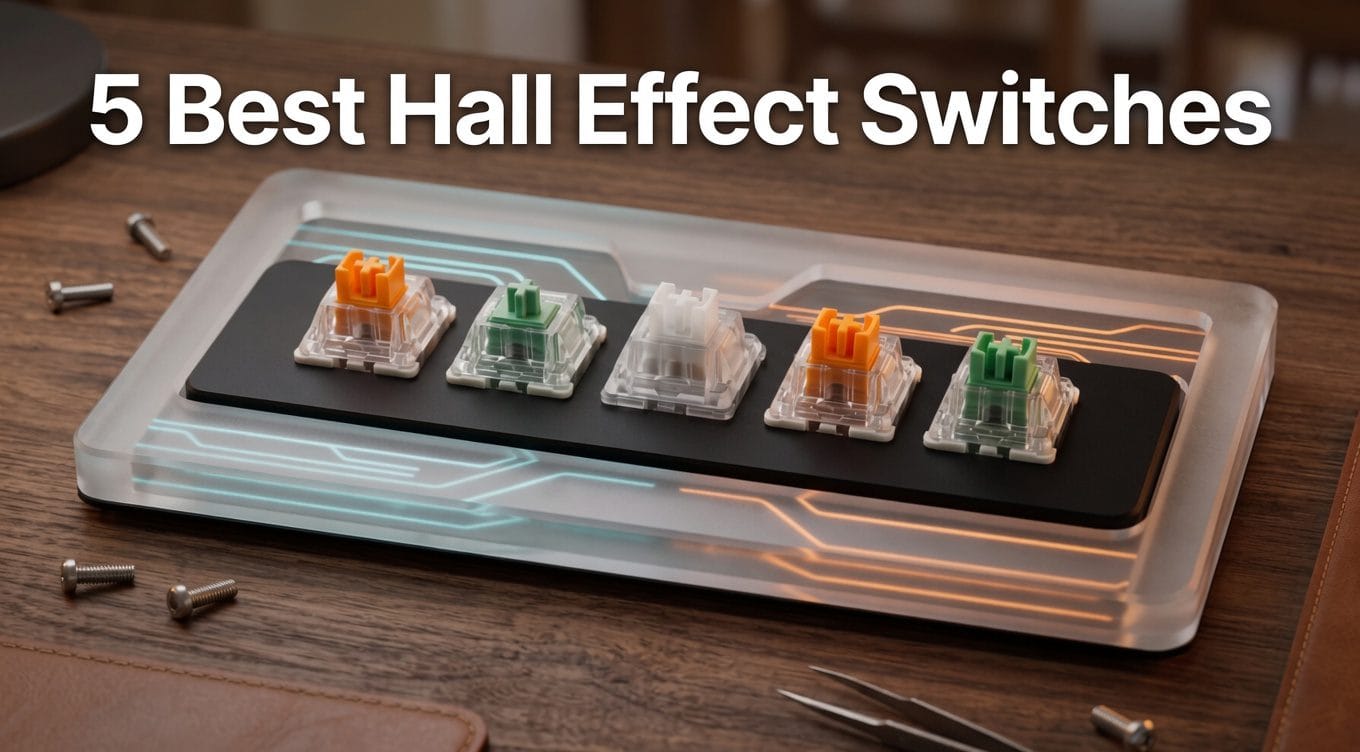
The 5 Best Hall Effect Switches (Magnetic) in 2026: A Research-Based Buyer’s Guide
Hall effect switches have a compatibility problem nobody puts on the box. Buy the wrong one and it won’t just fail to register, LumeKeebs warns a flux mismatch can outright damage an HE keyboard’s PCB. a high-end board, killed by a single bag of switches.
The labeling is a mess too. Aggregators routinely call the Gateron Magnetic Jade Pro “tactile”, it isn’t; that’s its Emerald sibling. Search for the Geon Raw HE and half the results are the Raw Zero, a different non-magnetic switch entirely.
This guide cuts through that. Five switches made the roster, not seven, not ten, because five is what survived our sourcing bar. Each pick comes with both force figures (actuation and bottom-out), a verified variant identity, and a spot in a cross-board compatibility matrix no competing guide publishes.
The Gateron Magnetic Jade Pro is the best hall effect switch for most buyers: a smooth linear rated at 36±5gf initial and 50±10gf bottom-out, with the tightest housing in its class, the widest board compatibility, and the deepest independent review coverage of any loose HE switch. Pricier rivals buy you less wobble or a deeper sound, not better all-round value.
Quick Verdict: The 5 Picks
- Best Overall, Gateron Magnetic Jade Pro. The switch everyone else gets benchmarked against; confirmed linear at 36±5gf / 50±10gf across Gateron, IQUNIX, and CannonKeys sheets, not tactile, whatever aggregators say.
- Best Budget / Best for Tuning, Gateron KS-20 Dual-Rail Magnetic Orange. ThereminGoat’s first HE deep-dive and 300th scored switch; a 4.1±0.2 mm long-travel rail bottom-out at ~50-52g.
- Best Sound, Meletrix WS Flux HE. A genuine new mold, octagonal stabilizing stem, four-point rebound; gadgetoid found it measurably more stable than the Jade Pro it’s pitched against.
- Best Premium, Geon Raw HE. Near-zero stem wobble across three spring weights (27/36/45gf initial), per Notebookcheck, the direct fix for Wooting Lekker V2 wobble.
- Best for Precision / Rapid Trigger, Durock Rock HE. Manufacturer-claimed <2Gs flux variation and 0.005 mm rapid-trigger stability, spec-sheet claims, not independently lab-verified; we explain the asterisk below.
What Is a Hall Effect (Magnetic) Switch?
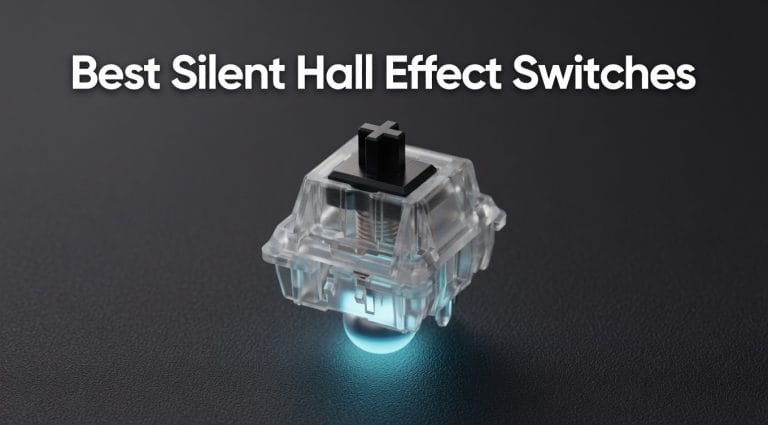
A hall effect switch, often just called a magnetic switch, registers keypresses with a magnet in the stem and a hall-effect sensor on the keyboard’s PCB, instead of the metal contact leaves inside a standard MX mechanical switch. The sensor reads magnetic flux continuously, so the board knows exactly how deep every key is pressed at every moment.
No physical contact also means less to wear out, Gateron rates the Jade Pro at 100 million keystrokes and the Dual-Rail Orange at 150 million, per its official sheets.
Adjustable Actuation, Rapid Trigger & Analog Input
Because the sensor tracks position rather than a single contact point, HE boards let you set the actuation point yourself, hair-trigger for gaming, deeper for typing. Rapid trigger resets a key the instant it starts moving upward, the feature competitive players chase these switches for.
Good for gaming? That’s the whole sales pitch, Durock advertises 0.005 mm of rapid-trigger stability on the Rock HE, though no independent lab has verified that number yet. Analog input goes further still, mapping key depth to a value like a controller stick.
Why HE Switches Are NOT Cross-Compatible
Unlike MX switches, hall effect switches are not interchangeable between boards. Three things break compatibility: magnet pole orientation (most switches here face the N-pole at the PCB; some boards read S-pole), magnet strength, and PCB thickness, 1.2 vs 1.6 mm changes the flux the sensor reads.
The Durock Rock HE sheet shows it plainly: bottom-out flux reads 640±60Gs on a 1.2 mm PCB but only 480±60Gs on 1.6 mm. Same switch, different board, different signal.
And the stakes are real: per LumeKeebs, a mismatch can damage the HE PCB itself. Check the matrix below before buying anything.
Comparison Table: All 5 Hall Effect Switches at a Glance
| Switch | Third-party score | Best for | Type (mfr sheet) | Actuation / bottom-out | Pins | Housing / stem |
| Gateron Magnetic Jade Pro | n/a | Best overall | Linear | 36±5gf* / 50±10gf | n/a, verify | PC top, nylon bottom, POM stem |
| Gateron KS-20 Dual-Rail Orange | ThereminGoat reviewed, score to pin at audit | Best budget / tuning | Linear | 30±7gf / ~50g† | n/a, verify | Clear top, white bottom, orange POM stem |
| Meletrix WS Flux HE | ThereminGoat reviewed, score to pin at audit | Best sound | Linear | 35±5gf / 50±7gf | n/a, verify | PC top + PC bottom, POM stem |
| Geon Raw HE | n/a | Best premium | Linear | 27/36/45gf / 40/50/60gf (three weights) | 2-pin | PC top, nylon bottom, POM stem |
| Durock Rock HE | n/a, no independent review found | Precision / rapid trigger (spec claim) | Linear (HE) | 35g / 48g | Unclear, Milktooth lists 5-pin; verify | Modified PC housing, long-pole POM stem |
* Nominal 36gf everywhere, but the printed tolerance varies by seller (±5 / ±7 / ±10), see the spec normalization table below. † LumeKeebs lists 50g; ThereminGoat’s measurement came in around 52gf.
The 5 Best Hall Effect Switches of 2026
1. Gateron Magnetic Jade Pro, Best Overall
When a rival launches a new magnetic switch, this is the one they compare it to, Wuque pitches its WS Flux HE directly against the Jade Pro.
Overview. The Jade Pro is the flagship of Gateron’s KS-20 magnetic family: a linear HE switch, PC top / nylon bottom / POM stem, 3.5±0.1 mm total travel. Gateron’s sheet lists 120±8Gs initial flux, 700±30Gs at bottom-out (1.2 mm PCB), a 100-million-keystroke rating, and factory lube.
One thing competitors get wrong constantly: this switch is linear, Gateron, IQUNIX, CannonKeys, and halleffectkeyboard.com all confirm it. The tactile one is the Magnetic Jade Emerald sibling, which Notebookcheck covered as Gateron’s answer to the Glorious Panda HE and AEboards Raeds.
The family sprawls: the base Jade (30±7gf / 50gf), the Max, Ruby, Air, Ultra, and Low-Profile, and, as of April 2026, the Jade Attraction, a distinct product listing 30±3gf at both points with a shorter 3.2±0.2 mm travel. Don’t let a seller quote Attraction numbers on a Pro listing.
Core Specs
- Type: Linear hall effect (Gateron official)
- Actuation force: 36gf nominal, printed as 36±5gf (Gateron, IQUNIX, KPrepublic, CannonKeys), 36±7gf (Amazon/Newegg listings), 36±10gf (NuPhy)
- Bottom-out force: 50±10gf (consistent across sellers)
- Travel: 3.5±0.1 mm total
- Materials: PC top / nylon bottom / POM stem
- Magnetic flux: 120±8Gs initial / 700±30Gs bottom-out (1.2 mm PCB, per Gateron)
- Lifespan: 100 million keystrokes; factory lubed
Acoustic Profile & Typing Feel
The Jade Pro bottoms out on the pole, per LumeKeebs’ head-to-head, a louder, higher-pitched landing than the Orange’s softer rail strike. Combined with the tight PC-over-nylon housing, its reputation is a clean, firm, controlled stroke.
Pros
- The most-documented mainstream HE linear: three-plus credible sources confirm type and both forces
- Widest availability and board coverage of any switch here
- Tight housing, factory lube, 100M-keystroke rating
Cons
- Seller force-spec inconsistency (±5 vs ±7 vs ±10 on the same 36gf nominal)
- Heavy successor churn, Emerald, Attraction, Max, Ruby make buying the right Jade confusing
- Fits only select HE PCBs per CannonKeys; not compatible with the Boog75
- Third-party resellers often inflate prices, verify the seller
Best For. Anyone building their first hall effect board, especially a Wooting 60HE or 80HE, who wants the safest, best-verified choice rather than a gamble on a newer mold.
The Verdict. Across Gateron, IQUNIX, and CannonKeys spec sheets, the Jade Pro is confirmed linear at 36±5gf initial / 50±10gf bottom-out by three independent listings, the benchmark every other switch on this page is measured against.
2. Gateron KS-20 Dual-Rail Magnetic Orange, Best Budget / Best for Tuning
When ThereminGoat finally wrote his first hall effect deep-dive, this is the switch he chose, his 300th scored switch, no less. For a budget pick, that’s an absurd paper trail.
Overview. The Dual-Rail Orange is a light linear: 30±7gf initial per Gateron’s sheet, bottoming out around 50g per LumeKeebs, ThereminGoat’s own measurement landed near 52gf. Some sellers print “38/50gf” instead; that’s a conflation of two different figures, not a different switch.
Travel is the standout spec, 4.1±0.2 mm, noticeably longer than the Jade Pro’s 3.5 mm; the rest of the sheet sits in the specs below.
The variant trap is housing shape. This is the KS-20/KS-20U build, open-hole bottom housing, per ThereminGoat’s teardown, not the original single-rail “Magnetic Orange,” and not the flat, closed-bottom KS-20T/KS-37 versions with different board compatibility.
Core Specs
- Type: Linear hall effect (Gateron, ThereminGoat, LumeKeebs)
- Actuation force: 30±7gf initial
- Bottom-out force: ~50g (LumeKeebs); ThereminGoat measured ~52gf
- Travel: 4.1±0.2 mm total
- Housing: clear top over white bottom, orange POM stem, open-hole bottom (KS-20/KS-20U)
- Magnetic flux: 102±15Gs initial; bottom-out conflict logged, 905±80Gs (Gateron official) vs 700±80Gs (ukeebs)
- Lifespan: 150 million keystrokes; N-pole faces PCB
Acoustic Profile & Typing Feel
Dual rails, not the pole, take the bottom-out here, softer and deeper than the Jade’s sharper pole strike, per LumeKeebs. Add the extra 0.6 mm of travel and you get the roomiest, most cushioned stroke on this list.
That long travel is the honest trade-off: 4.1 mm works against a short, snappy gaming stroke, and is the entire appeal for full-bodied budget typing.
Pros
- Competitive per-switch cost on the roster
- The deepest independent documentation of any budget HE switch, a full ThereminGoat teardown and score
- Dual-rail bottom-out gives a distinct, deeper sound signature
- Long 4.1 mm travel suits tuners and heavy typists
Cons
- 4.1 mm travel is not for everyone, it’s the longest here by a clear margin
- Conflicting published specs: bottom-out flux differs by 205Gs between Gateron and ukeebs, and some sellers misprint the forces as “38/50gf”
- A third top-tier source beyond ThereminGoat and Gateron is still outstanding
Best For. Budget builders and tinkerers who want to experiment with HE tuning on a 70-pack that costs less than a boutique 10-pack of premium switches.
The Verdict. With a full ThereminGoat deep-dive behind it, his 300th scored switch, the Dual-Rail Orange is the best-documented budget HE switch available.
3. Meletrix WS Flux HE, Best Sound
Most “new” HE switches are re-colors of someone else’s mold. The WS Flux HE is not, and its whole design brief reads like a targeted strike on the Jade Pro’s weaknesses.
Overview. Built by Wuque Studio as a WS×K2 collaboration, the Flux HE pairs full polycarbonate housings with an octagonal POM stabilizing stem, dual T-rails, four-point rebound, and four-point precision factory lube, per Wuque’s spec sheet and ThereminGoat’s full review.
Forces are, unusually for this category, independently corroborated: the Meletrix/Amazon listing says 35±5gf initial / 50±7gf bottom-out, and ThereminGoat’s own measurement put bottom-out right around 50gf.
One naming landmine: the WS Dash HE is a Wuque re-color of the Gateron Magnetic Jade, not this new mold. Same brand, different switch, never cross their specs.
Core Specs
- Type: Linear hall effect (Wuque, ThereminGoat, MaxGaming)
- Actuation force: 35±5gf initial
- Bottom-out force: 50±7gf listed; ~50gf per ThereminGoat’s measurement
- Travel: 3.50±0.10 mm total
- Materials: PC top + PC bottom, octagonal POM stem
- Structure: dual T-rail, four-point rebound, four-point precision lube
- Magnetic flux: 115±15Gs initial / 635±50Gs bottom-out (1.6 mm PCB)
Acoustic Profile & Typing Feel
“Deep Clacky” is Wuque’s own billing, and the all-PC housing is the engine behind it, a fuller, rounder strike than nylon-bottomed rivals.
Stability is its cleanest punch: gadgetoid found the octagonal stem measurably reduces 45-degree deflection, calling it noticeably more stable than the Jade Pro. His one wish, a stiffer-spring variant, doubles as its main limitation.
Pros
- The most stable stem in this roundup short of the Geon, per gadgetoid’s deflection findings
- Distinctive deep-clacky sound signature from full-PC housings
- Forces independently corroborated by ThereminGoat, rare at this price tier
Cons
- Premium pricing relative to the rest of this roster
- One spring weight only, gadgetoid explicitly wished for a stiffer option
- Board compatibility is not yet documented in our source log, verify against your PCB before buying
Best For. Sound-first builders who choose switches by ear and are willing to pay boutique pricing for a deep, clacky profile with genuinely reduced stem wobble.
The Verdict. Unlike the Jade Pro it’s openly pitched against, the Flux HE’s octagonal stem measurably cut 45-degree deflection in gadgetoid’s testing, stability and sound that sets it apart.
4. Geon Raw HE, Best Premium / Enthusiast Pick
Wooting’s stock Lekker V2 switches have a known wobble complaint. The Raw HE exists specifically to end it, and Wooting now sells it on their own store.
Overview. GeonWorks builds the Raw HE in three spring weights, so a single force number is flat-out wrong here: initials run 27 / 36 / 45gf, bottom-outs 40 / 50 / 60gf. Notebookcheck’s coverage of the middle Raw HE 50 lists 36gf initial / 50gf bottom-out.
The bottom housing is half-closed with a through-hole pole touch, Wooting’s listing credits that construction with a distinct sound. The full sheet sits in the specs below.
Now the trap: the Geon Raw Zero is not this switch. It’s a conventional non-HE MX linear, 62g bottom-out, 21 mm spring, 5-pin, that floods search results for “Geon Raw.” If a listing says 62g or 5-pin, wrong product.
Core Specs
- Type: Linear hall effect, factory lubed (GeonWorks, Notebookcheck, Wooting)
- Actuation force: 27 / 36 / 45gf initial, by spring weight
- Bottom-out force: 40 / 50 / 60gf, by spring weight
- Travel: 3.4 mm; 15 mm single-stage spring; 2-pin
- Materials: PC top / nylon bottom / POM stem; half-closed bottom with pole touch
- Magnetic flux: 160Gs initial / 720Gs bottom-out
- Wooting note: only the Raw HE 50 is confirmed compatible with Wooting Spring Packs (Notebookcheck)
Acoustic Profile & Typing Feel
Notebookcheck characterizes the sound as medium, between clacky and poppy, a product of the half-closed bottom and pole touch Wooting’s listing singles out. A firmer, more precise voice than the Flux’s deep clack.
Feel is the headline. Near-zero stem wobble is the claim Notebookcheck leads with, and Eloquent Clicks user reviews echo it on the Wooting 60HE, the exact board whose stock switches drew the complaints.
Pros
- Near-zero stem wobble, per Notebookcheck, the tightest feel-focused claim on this list with independent backing
- Three real spring weights (27/36/45gf initial) instead of one-size-fits-all
- Sold and endorsed by Wooting itself as an upgrade path
Cons
- Premium pricing sold in small 10-pack quantities, filling a full board costs planning
- Only the Raw HE 50 weight is confirmed for Wooting Spring Packs, the 40 and 60 are not
- A third top-tier independent source beyond Notebookcheck is still outstanding
- The Raw Zero naming collision makes mispurchase genuinely easy
Best For. Wooting 60HE/80HE owners who find stock Lekker V2 wobble unacceptable, and anyone who wants to pick an exact spring weight rather than accept a default.
The Verdict. Notebookcheck credits the Raw HE line with near-zero stem wobble across all three weights (27/36/45gf initial), the specific fix Wooting owners had been asking for since the Lekker V2 complaints surfaced.
5. Durock Rock HE, Best for Precision / Rapid Trigger (With an Asterisk)
On paper, this is the precision play of the entire category. In practice, “on paper” is doing all the work, and we’re going to be upfront about that.
Overview. The Rock HE is Durock’s first hall effect switch. Its published spec claims under 2Gs of flux variation between units and 0.005 mm of rapid-trigger stability, numbers that would make it the consistency champion here, if accurate. No independent lab has verified either figure, and we found no ThereminGoat, Notebookcheck, or comparable review this cycle. Treat every performance claim accordingly.
The verifiable hardware checks out across sources: Durock, Amazon’s listing, and Milktooth all agree on 35g initial / 48g bottom-out, the full sheet sits in the specs below.
Flux is explicitly PCB-thickness dependent: 100±15Gs / 640±60Gs on a 1.2 mm PCB, dropping to 90±15Gs / 480±60Gs on 1.6 mm. One open discrepancy: Milktooth lists “PCB 5-pin” where most HE switches are 2-pin, unverified at press time.
And don’t confuse it with the Durock Dolphin: the Dolphin is a silent, silicone-dampened MX linear with a 62g bottom-out and no magnet anywhere in it. Different technology entirely.
Core Specs
- Type: Hall effect linear (Durock/CE Guild, Amazon, Milktooth)
- Actuation force: 35g initial (spacebar variant: 50g)
- Bottom-out force: 48g (spacebar variant: 63.5g)
- Travel: 3.4±0.2 mm; long-pole POM stem; 15.5 mm stainless spring
- Housing: modified PC; N-pole down
- Magnetic flux: 100±15Gs / 640±60Gs at 1.2 mm PCB; 90±15Gs / 480±60Gs at 1.6 mm
- Manufacturer claims (not independently verified): <2Gs unit-to-unit variation; 0.005 mm rapid-trigger stability
- Packaging: 70-piece pack with a bonus spacebar switch (Amazon listing)
Acoustic Profile & Typing Feel
Honesty required here: no independent reviewer has published sound or feel findings for the Rock HE. A long-pole stem typically means an earlier, sharper pole strike, but that’s inference from parts, not a documented result.
Durock’s compatibility notice, echoed by Milktooth, spans Wooting, SteelSeries, Corsair, NuPhy, MelGeek, Matrix Lab, and KBDfans boards. Real breadth, but it too rests on manufacturer and retailer documentation, not third-party testing.
Pros
- The tightest published precision spec in the category, if it holds up
- Broad manufacturer-listed board compatibility across seven brands
- Generous value: a 70-pack with a bonus spacebar switch
Cons
- Not independently lab-verified, no credible third-party review exists as of this cycle
- Pin count is unclear (Milktooth’s “5-pin” listing conflicts with the 2-pin HE norm)
- Durock’s first HE switch, no track record to lean on
Best For. Rapid-trigger-focused gamers who understand they’re betting on a spec sheet, and who’d rather take that bet at fifty cents a switch than at two dollars.
The Verdict. On paper, Durock’s <2Gs flux-variation claim is the strongest precision spec on this page, but until an independent lab confirms it, treat the Rock HE as a promising data sheet, not a proven winner.
Acoustic Profile & Typing Feel: How the Five Actually Differ
The biggest sound variable here is what the stem lands on. Pole bottom-out, the Jade Pro’s approach, strikes harder and higher-pitched; rail bottom-out, the Orange’s dual rails, the Flux’s T-rails, lands softer and deeper, per LumeKeebs’ Jade-vs-Orange comparison.
Housing material stacks on top. Full polycarbonate (WS Flux) leans clacky and resonant; a nylon bottom (Jade Pro, Geon) tempers it; and Geon’s half-closed bottom with pole touch produces what Wooting calls a distinct sound, Notebookcheck files it between clacky and poppy.
On feel, the documented hierarchy is unusually clear: Notebookcheck puts the Geon Raw HE at near-zero wobble, gadgetoid found the WS Flux more stable than the Jade Pro, and the Jade Pro remains the tight-but-beatable reference. Spring ping, lube consistency, and unit-to-unit QC variance are the wildcards no spec sheet captures, exactly why we weight independent teardowns over marketing copy.
Compatibility Matrix: Which Switch Works With Which Board
The table most guides skip, and the one that saves boards, given what a flux mismatch can do to a PCB.
| Switch | Wooting 60HE / 80HE | Keychron HE | Meletrix / MelGeek | SteelSeries / Corsair | Generic S-pole boards (e.g., Akko MOD007B) |
| Gateron Magnetic Jade Pro | KS-20 family supported (hlplanet, LumeKeebs) | verify | verify | verify | verify, likely no; confirm pole orientation |
| Gateron KS-20 Dual-Rail Orange | KS-20 family supported (hlplanet) | verify | verify | verify | N-pole faces PCB (Gateron) |
| Meletrix WS Flux HE | verify | verify | verify | verify | verify |
| Geon Raw HE | sold by Wooting; Raw HE 50 fits Wooting Spring Packs (Notebookcheck) | verify | verify | verify | verify |
| Durock Rock HE | * (Durock/Milktooth notice) | verify | * MelGeek listed (Durock/Milktooth) | * both listed (Durock/Milktooth) | N-pole down (Durock) |
* Manufacturer/retailer compatibility notice only, not independently verified. The Rock HE’s listed range also covers NuPhy, Matrix Lab, and KBDfans boards.
Two footnotes worth their weight in dead PCBs. The KS-37, the Orange’s flat-housing cousin, sold by Keychron as the “Nebula”, uses different-weight magnets: not Wooting-compatible, though it fits Keychron, MelGeek, and Meletrix boards (hlplanet). And per CannonKeys, the Magnetic Jade family fits only select HE PCBs, the Boog75 is out.
A isn’t a no, it means our source log holds no citation either way, and we won’t print a checkmark we can’t back.
Spec Normalization: Both Forces, Every Seller, Side by Side
Sellers routinely print one number where two exist, or the same nominal force with wildly different tolerances. Here is every logged force figure, normalized into a clean initial / bottom-out pair.
| Switch | Initial force as printed (source) | Normalized initial | Bottom-out as printed (source) | Normalized bottom-out | Conflicts logged |
| Magnetic Jade Pro | 36±5gf (Gateron, IQUNIX, KPrepublic, CannonKeys); 36±7gf (Amazon/Newegg); 36±10gf (NuPhy) | ~36gf | 50±10gf (IQUNIX, NuPhy, KPrepublic) | ~50gf | Same nominal force, three different printed tolerances, trust the manufacturer’s ±5 |
| KS-20 Dual-Rail Orange | 30±7gf (Gateron, Amazon, ukeebs) | ~30gf | 50g (LumeKeebs); ~52gf measured (ThereminGoat); some sellers misprint “38/50gf” | ~50–52gf | Bottom-out flux: 905±80Gs (Gateron) vs 700±80Gs (ukeebs), unresolved |
| WS Flux HE | 35±5gf (Meletrix/Amazon) | ~35gf | 50±7gf (Meletrix/Amazon); ~50gf measured (ThereminGoat) | ~50gf | None, independently corroborated |
| Geon Raw HE | 27 / 36 / 45gf by weight (GeonWorks, Delta Key, Eloquent) | 27 / 36 / 45gf | 40 / 50 / 60gf by weight (GeonWorks); Notebookcheck confirms 36/50 for the Raw HE 50 | 40 / 50 / 60gf | Single-number listings hide the three-weight structure |
| Durock Rock HE | 35g (Durock/CE Guild, Amazon, Milktooth) | 35g | 48g (same three sources); spacebar 63.5g | 48g | Pin count unresolved (Milktooth “5-pin” vs 2-pin HE norm) |
If a listing shows one force number for any of these, you now know which it is, and which it’s hiding.
How to Choose a Hall Effect Switch
Start with your board, not the switch. Pole orientation, magnet strength, and PCB thickness all gate compatibility (LumeKeebs). The matrix above is step one; your board maker’s supported list is step two.
Read both forces, always. Actuation is where the key registers, movable on HE boards. Bottom-out is what your fingers fight at full depth, always higher: the Jade Pro actuates around 36gf but bottoms out at 50±10gf. One printed number is half the story.
Match travel to use. Short-to-standard travel (3.2–3.5 mm) suits fast gaming resets; the Orange’s 4.1 mm stroke favors deliberate, cushioned typing. Neither is “better”, one fits you.
Decide what your ears want. Pole bottom-out reads sharp and bright; rail bottom-out soft and deep; all-PC housings amplify clack while nylon bottoms mellow it. Those design choices predict the sound better than any marketing adjective.
Then check the seller, not just the switch. Many Amazon US listings here are third-party reseller repackages of Gateron and Geon stock. Verify the pack count and seller rating before checkout, every time.
FAQ
Are Magnetic Jade switches linear or tactile? The base Magnetic Jade and the Jade Pro are linear, confirmed by Gateron’s sheets plus IQUNIX and CannonKeys listings. The tactile one is the Jade Emerald sibling, which ThereminGoat describes as a tactile-HE hybrid. Aggregators labeling the Pro “tactile” are mixing up the family.
Will Gateron KS-20 switches work in my Wooting 60HE? Yes, the Wooting 60HE+ and 80HE support KS-20-family magnets: Magnetic Jade, White, and Orange (hlplanet, LumeKeebs). The flat-housing KS-37 will not, its magnets are a different weight, though it fits Keychron, MelGeek, and Meletrix boards.
Is the Geon Raw HE actually better than the stock Wooting Lekker V2? On the complaint that matters, yes: Notebookcheck credits the Raw HE with near-zero stem wobble and frames it as a direct Lekker V2 fix. One catch, only the middle Raw HE 50 weight is confirmed compatible with Wooting Spring Packs.
Why aren’t hall effect switches cross-compatible like MX switches? Because the board reads a magnetic field, not a contact closure. Pole orientation must match the sensor, and PCB thickness (1.2 vs 1.6 mm) changes the flux it sees, the Rock HE’s sheet shows a 160Gs bottom-out difference between the two. Per LumeKeebs, a bad mismatch can even damage the PCB.
What’s the difference between actuation force and bottom-out force? Actuation force is the resistance where the keypress registers, often adjustable on HE boards. Bottom-out force is the resistance at full travel, always the higher number: the Jade Pro runs ~36gf actuation against ~50gf bottom-out, per manufacturer sheets.
Is the Durock Rock HE the same as the Durock Dolphin? No. The Dolphin is a silent, silicone-dampened MX linear (62g bottom-out) with no hall effect sensing at all. The Rock HE is Durock’s magnetic switch at 35g / 48g (Durock/CE Guild). Shared brand, unrelated products.
How We Researched This
This guide was compiled using a synthesis-based research methodology. Technical specifications come from official manufacturer spec sheets. Acoustic and typing-feel observations are drawn from published independent reviews (cited by name where they exist) and from the wider mechanical-keyboard enthusiast community.
No hands-on units were physically tested for this guide. Instead, we cross-referenced technical data and reviewer findings across multiple independent sources to compile an objective, comparative analysis. Where a claim reflects a manufacturer’s own rating rather than an independent measurement, we say so. For more details on our standards, please visit our dedicated Methodology page.
Buy the Benchmark, Skip the Guesswork
Five switches, one clear starting point. The Gateron Magnetic Jade Pro is the pick for most buyers, the only switch here with three independent listings agreeing on both forces (36±5gf / 50±10gf), the widest confirmed board support,and deep third-party review coverage.
Go Orange if the budget is tight, Flux if sound rules your builds, Geon if wobble drives you mad, and Rock HE only if you’re comfortable betting on an unverified spec sheet. Then do the one thing this category punishes skipping: check the compatibility matrix against your board before you click buy.