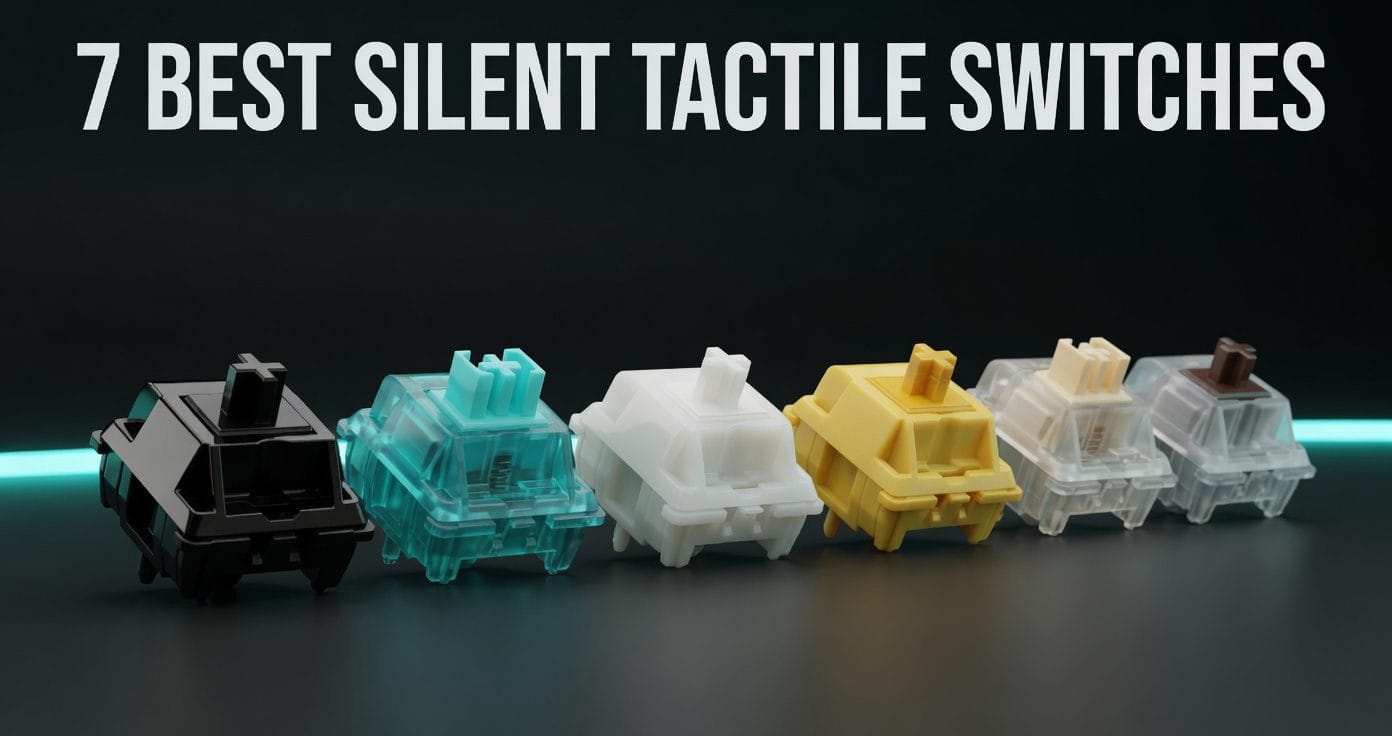
The 7 Best Silent Tactile Switches in 2026 (Firm Feel, No Fake Testing)
You want the bump. You don’t want the clack. That’s the whole problem with tactile switches in a shared office, a late-night bedroom, or on a hot mic.
Silencing a tactile switch usually means bolting silicone onto the stem — and that silicone is exactly what typists on r/MechanicalKeyboards call “mushy.” So the real question isn’t just which switch is quietest. It’s which one stays quiet without turning the bottom-out to mush.
This guide ranks seven silent tactile switches across three price tiers. Every pick is built from published reviews, force-curve databases, and manufacturer spec sheets — cross-checked, never touched by us. Where sources disagree, we show the spread instead of guessing.
The TTC Silent Bluish White V2 is the strongest silent tactile pick for most buyers: its 50 g bottom-out uses a hardened pad inside the housing well rather than silicone on the stem rails, so the keypress stays firm instead of cushioned — and Milktooth’s 2025 roundup ranks it the best-balanced silent tactile of the group. Heavier and lighter hands have better-matched picks below.
Quick Verdict: The Picks at a Glance
- Best overall (balanced): TTC Silent Bluish White V2 — 50 g bottom-out with an in-housing dampening pad; Milktooth’s top-ranked silent tactile.
- Best premium: Gazzew Boba U4 — the only pick here with a published score, rated 85/100 by ThereminGoat.
- Best budget: Akko Penguin Switch (Silent) — factory-lubed early bump, rated lighter than most switches by Milktooth.
- Best non-mushy: Wuque Studio WS Silent Tactile — Haimu’s stem-cutout silencing keeps a firm 63.5 g bottom-out with no silicone.
- Best heavy: Durock Shrimp Silent T1 — a 67 g bottom-out and JWK’s sharp T1 bump, dampened by silicone rings.
- Best value punch: Outemu Silent Yellow Jade — an early tactile event logged at 0.70 mm by KBD.news.
- Best light/crisp: WingTree x Lichicx Yamatake — a 42–53 g brown-style bump with a pooling-resistant factory lube job.
Comparison Table
| Switch | Bottom-out | Silencing method | Bump type | Independent score | Best for |
| Gazzew Boba U4 | 62 g / 68 g | Silicone stem dampeners | Rounded “D,” no pre-travel | ThereminGoat 85/100 | Premium quiet + strong bump |
| TTC Silent Bluish White V2 | 50 g | Bottom-well pad + upper silicone ring | Medium stepped, early | n/a — no published lab score | Balanced all-rounder |
| Akko Penguin Switch (Silent) | 60 g | Silicone rail dampeners | Early “P” bump | n/a — no published lab score | Budget builds |
| Wuque Studio WS Silent Tactile | 63.5 g | Stem relief cutouts (no silicone) | Medium, top-of-travel | n/a — no published lab score | Firm, non-mushy feel |
| Durock Shrimp Silent T1 | 67 g | Silicone rings (rails) | Sharp, stepped (T1) | n/a — no published lab score | Heavy-handed typists |
| Outemu Silent Yellow Jade | 65 g | Silicone stem dampeners | Early, punchy (0.70 mm) | n/a — no published lab score | Value + snappy return |
| WingTree x Lichicx Yamatake | 42 g / 53 g | POM + silicone silencer | Gentle “brown-style” | n/a — no published lab score | Light, crisp typing |
Acoustic Architecture: How a Tactile Switch Goes Quiet
Two collisions make a switch loud: the downstroke, when the stem bottoms out against the base, and the upstroke, when the stem shoulders slam the top housing on release. Silent switches attack both — and the method they use predicts how they feel.
Silicone dampening (viscoelastic). Soft pads on the stem rails absorb a large share of the impact energy, turning the clack into a low thud. It’s the quietest approach, but the cushioning softens the end of the stroke — the “mushy” feel enthusiasts complain about. The Boba U4, Akko Penguin, and Outemu Yellow Jade all use this route.
Structural relief (cutouts). Instead of silicone, precise cutouts in the stem rails flex on impact to dissipate energy. Noise drops without a soft pad, so the bottom-out stays firm. Haimu’s WS Silent Tactile is the clearest example — Kinetic Labs calls its bottom-out firm rather than cushioned.
In-housing pad. TTC places a hardened pad in the bottom-housing well and a silicone ring around the upper stem, so the rails still make clean contact. That keeps the bottom-out snappy while muting the pole impact.
Then there’s the upstroke. Downstroke dampening is the easy half; the return clack often slips past it. It’s why the WS Silent Tactile — quiet going down — still produces an audible pop as the POM stem rebounds against its nylon top housing (Kinetic Labs). Housing material matters here too: PC and POM tops ring higher and snappier, while nylon (PA66) absorbs more and sounds deeper.
Finally, spring ping and leaf crunch. As the tactile legs drag across the contact leaf, friction can produce a metallic scratch or ping, and a long spring can ring laterally on release. Tight tolerances, good steel, and precise factory lube are what keep those resonances down.
The Tactile Curve: D-Shape vs P-Shape
The shape of the bump sets the rhythm of your typing. A rounded “D-shape” profile — the Boba U4’s signature — rises immediately with no pre-travel and stays smooth and rounded across the stroke, closer to a Topre-style feel. There’s no discrete actuation point to quote; the resistance simply begins at the top of the press.
An early stepped “P-shape” profile — the Akko Penguin, the Outemu Yellow Jade — puts a sharp, localized bump near the top of travel, often around 0.4–0.7 mm, then drops into a lighter run to the bottom. It reads as a crisp click of feedback early, then a clean glide. KBD.news logs the Yellow Jade’s event at exactly 0.70 mm.
Whether a switch feels mushy at the end comes down to how its dampening interacts with spring return. Soft, thick silicone plus a weak spring feels spongy; a firmer pad, a cutout design, or a snappier spring keeps structure in the bottom-out.
Gazzew Boba U4
Overview. Designed by Gazzew and manufactured by Outemu, the Boba U4 built its reputation on tolerances. ThereminGoat’s review — one of the few genuine force-curve write-ups in this whole category — rates it 85/100 and singles out near-perfect wobble control in both directions. Its “D” stem carries rubber dampeners on down- and up-stroke.
Core Specs.
- Type: silent tactile, 5-pin PCB mount
- Bottom-out: 62 g or 68 g (two spring options)
- Stem: POM; housing: Gazzew’s proprietary plastic blend
- Stem profile: rounded “D,” no pre-travel (no discrete actuation point)
- Factory light lube
Sound & Feel. ThereminGoat describes a muted, matte, low thud with strong leaf stability — but also flags a mild dry “leathery” slide that a light rail lube cleans up. One history note worth knowing: the old Milky/pearl housing was discontinued over long-term yellowing and replaced by an all-black housing that doesn’t discolor (PantheonKeys).
Pros
- Only pick here with a published independent score (ThereminGoat 85/100)
- Pronounced rounded bump, no pre-travel; benchmark tolerance consistency
- Two weights (62 g / 68 g) for lighter or heavier hands
Cons
- Premium price — the dearest in this roster
- A faint dry slide before break-in
- Older Milky housing yellowed over time (buy the current black housing)
Best For. Typists who want the most pronounced silent bump on the market and will pay for consistent tolerances.
The Verdict. ThereminGoat scored the Boba U4 85/100 — the only lab-style figure in this roster — which keeps it the premium benchmark for a rounded, whisper-quiet bump.
TTC Silent Bluish White V2
Overview. The Bluish White V2 silences itself differently from most of this list. Rather than co-molding pads onto the stem rails, TTC drops a hardened pad into the bottom-housing well and wraps a silicone ring around the upper stem, so the rails still land clean. CtrlShiftStore’s spec sheet confirms a 42 gf operating force, a 58 gf tactile peak, and a double-stage spring; Milktooth ranks it the best-balanced silent tactile of 2025.
Core Specs.
- Type: silent tactile, 5-pin PCB mount
- Bottom-out: 50 g (42 gf operating, 58 gf tactile peak — CtrlShiftStore)
- Stem: POM; housing: PC top, PA66 nylon bottom
- Silencing: bottom-well pad + upper silicone ring
- Spring: double-stage gold-plated
Sound & Feel. Milktooth describes the sound as rain on a window — soft, background-friendly — and credits the double-stage spring for a quick return that resists sluggishness. Because the dampening sits in the housing rather than on the rails, the bottom-out reads firmer than a typical silicone-padded silent switch.
Pros
- Firm, non-mushy bottom-out from the in-housing pad design
- 50 g sits between light and heavy — the broadest appeal here
- Milktooth’s top-ranked silent tactile for balance
Cons
- No published lab score for independent verification
- Some early unlubed batches showed upstroke clatter; a light top-housing lube resolves it (community reports)
Best For. The typist who doesn’t yet know their weight preference and wants the safest all-round silent tactile.
The Verdict. A 50 g bottom-out paired with an in-housing dampening pad is what earns the Bluish White V2 Milktooth’s best-balanced ranking — firm feedback most hands adapt to instantly.
Akko Penguin Switch (Silent)
Overview. The Penguin Silent is the budget anchor here, factory-lubed for smooth travel out of the pack. It runs an early “P”-shaped bump over a short 3.3 mm travel, with silicone rail dampeners handling the noise. Milktooth’s 2024 roundup makes it their top budget silent-tactile pick. Spec sheets vary on actuation — some list ~43 gf, Akko’s own ~50 gf — so treat the light end as a range, not a fixed number.
Core Specs.
- Type: silent tactile, 5-pin PCB mount
- Bottom-out: 60 g; actuation listed ~43–50 gf across sources
- Stem: POM; housing: PA nylon top and bottom
- Total travel: ~3.3 mm (short); factory lubed
Sound & Feel. Milktooth rates the Penguin’s tactility as medium-light and quieter than a typical membrane office board, with the silicone rails muffling impact into a soft thud. Factory lube keeps travel clean, though it carries a touch more stem wobble than the premium picks.
Pros
- Among the cheapest switches in this roster
- Factory-lubed, smooth and responsive out of the box
- Short 3.3 mm travel suits fast typing and gaming
Cons
- Softer, mushier bottom-out than higher-durometer premium designs
- Slightly more stem wobble
- No published lab score
Best For. A first silent-tactile build, or kitting out a full board on a tight budget.
The Verdict. The Penguin undercuts every premium pick here while Milktooth still rates its 60 g bump on the lighter side — a rare budget-and-comfort combination.
Wuque Studio WS Silent Tactile
Overview. Developed by Wuque Studio in partnership with Haimu — Wuque has been Haimu’s design partner on WS switches since 2022, per Wuque’s own announcement — the WS Silent Tactile silences the downstroke with stem-rail cutouts instead of silicone. Kinetic Labs highlights the result: a firm, rigid bottom-out closer to a normal tactile than a cushioned one, with a medium bump comparable to a Boba U4.
Core Specs.
- Type: silent tactile, 5-pin PCB mount
- Bottom-out: 63.5 g
- Stem: POM; housing: nylon top and bottom
- Silencing: stem relief cutouts (no silicone)
- Spring: 15 mm single-stage; total travel ~3.50 mm; factory lubed
Sound & Feel. Kinetic Labs and Milktooth agree: the downstroke is genuinely quiet, but this is a “quiet,” not “silent,” switch — the POM stem pops against the nylon top housing on release. Kinetic Labs calls the bump medium rather than sharp and praises unusually consistent factory lube on their sample.
Pros
- Cutout silencing keeps a firm, non-mushy bottom-out
- Medium bump comparable to Boba U4 (Kinetic Labs)
- Factory lube praised as consistent
Cons
- Audible upstroke pop — not for those chasing absolute silence
- A silent linear WS variant shares similar numbers; confirm you’re buying the tactile
Best For. Enthusiasts who want silence but refuse to give up a rigid, standard-feeling bottom-out.
The Verdict. Haimu’s stem cutouts give the WS Silent Tactile a 63.5 g bottom-out that Kinetic Labs calls firm rather than cushioned — the pick when mushiness is the dealbreaker.
Durock Shrimp Silent T1
Overview. Manufactured by JWK, the Shrimp is the silent version of the popular Durock T1. It keeps the sharp, stepped T1 tactility and adds silicone rings to dampen both bottom-out and top-out. At a 67 g bottom-out with 52 g actuation, it’s the heaviest switch in this roster.
Core Specs.
- Type: silent tactile, 5-pin PCB mount
- Bottom-out: 67 g (≈52 g actuation); gold-plated spring
- Stem: POM with silicone ring
- Housing: polycarbonate top, polymer-nylon bottom (turquoise/translucent blue)
- Total travel: reported 3.8–4.0 mm across sources; factory lubed
Sound & Feel. KeebWorks calls the Shrimp’s tactility sharper and heavier than a Boba U4, and smooth at normal speeds. Two honest caveats from that same review: a faint spring ping audible only in a dead-silent room, and a weak return spring that can leave the spacebar or other stabilized keys sticking — the same trait the original T1 had.
Pros
- Heaviest, sharpest bump here (67 g) for deliberate keypresses
- Dual silicone-ring dampening on down- and up-stroke
- Smooth at normal typing speeds (KeebWorks)
Cons
- Weak spring can cause spacebar/large-key sticking (KeebWorks) — a Cherry MX Clear spring swap fixes it
- Faint spring ping in silent rooms
- Translucent housing tints RGB
Best For. Heavy-handed typists who want maximum tactility and don’t mind a spring swap on the spacebar.
The Verdict. For heavy hands, the 67 g Shrimp hits harder than anything else here — just budget for a possible spacebar spring swap, the one flaw KeebWorks flags on it and the original T1 alike.
Outemu Silent Yellow Jade
Overview. The third generation of Outemu’s silent tactile line, the Yellow Jade puts its tactile event early — 0.70 mm into the press, per KBD.news — over silicone stem dampeners. OZO and Milktooth both describe a “thocky,” crisp signature rather than the muffled softness of many budget silent switches.
Core Specs.
- Type: silent tactile, 5-pin PCB mount
- Actuation 50 g / bottom-out 65 g / total travel 3.3 mm (KBD.news, OZO)
- Tactile bump: 45 g at 0.70 mm (KBD.news)
- Stem: dustproof POM; housing: PA66 nylon; factory lubed
Sound & Feel. The sound stays office-appropriate while keeping a crisp bump. Outemu markets “up to 95% noise reduction” and a “foam-infused POM stem,” but neither is independently measured — treat both as manufacturer copy. The real silencing is standard silicone stem pads. One build note: the copper pins are softer than premium switches, so seat them carefully in hot-swap sockets.
Pros
- Early, punchy bump (0.70 mm) with a snappy return
- Among the cheapest switches in this roster
- Dustproof POM stem, PA66 housing, factory lubed
Cons
- Soft pins prone to bending on insertion
- No published lab score
- Headline “95%” and “foam-infused” are unverified marketing — don’t buy on those
Best For. Budget builders who want a snappy silent tactile rather than a soft, cushioned one.
The Verdict. KBD.news logs the Yellow Jade’s tactile event at 0.70 mm — early and punchy — which makes it the value pick for typists who want snap over cushion.
WingTree x Lichicx Yamatake
Overview. Designed by XLLAB and built under the WingTree/Lichicx banner, the Yamatake is the light-and-crisp entry here. It offers two weightings — 35 g/45 g actuation, 42 g/53 g bottom-out — on a POM-plus-silicone stem, with a housing OZO notes is tuned for low stem wobble. The bump reads as a soft “brown-style” feel.
Core Specs.
- Type: silent tactile, 5-pin PCB mount
- Actuation 35 g / 45 g · bottom-out 42 g / 53 g (OZO)
- Pre-travel 2.0 mm · total travel 3.8 mm
- Stem: POM + silicone silencer; housing: PC top, PA66 bottom
Sound & Feel. OZO describes a warm, “porridge”-like muted profile with a bottom-out that stays crisp rather than mushy. Its lube job is unusually deliberate: UniKeys documents 205g0 on the stem sliders and legs, a dry-film coating on the spring and leaf, and no wet lube in the bottom housing — a layout specifically meant to prevent lubricant pooling over time.
Pros
- Lightest options here (42 g / 53 g bottom-out) — low fatigue
- Crisp, non-mushy bottom-out despite silicone silencing
- Pooling-resistant factory lube (205g0 + dry-film, per UniKeys); low stem wobble
Cons
- Gentle bump may feel too subtle for tactile-heavy typists
- No published lab score
- A separate HMX-made “Yamatake” exists — buy the WingTree × Lichicx
Best For. Long typing sessions where a light, quiet, low-fatigue switch beats a big bump.
The Verdict. With a 42–53 g bottom-out range and a soft brown-style bump, the Yamatake reads as the lightest, lowest-fatigue silent tactile here — the office-marathon pick.
Original Analysis: Silencing-Mechanism Normalization
Silent tactiles get lumped together, but they silence themselves in three mechanically distinct ways — and the method predicts the feel. Every cell below traces to the sources cited in each product section.
| Switch | Silencing category | Bottom-out | Bump shape | Sound descriptor (source) |
| Gazzew Boba U4 | Viscoelastic (stem-rail pads) | 62 / 68 g | Rounded “D,” no pre-travel | Muted low thud (ThereminGoat) |
| TTC Bluish White V2 | In-housing pad + upper ring | 50 g | Medium stepped, early | Rain-on-window (Milktooth) |
| Akko Penguin Silent | Viscoelastic (rail pads) | 60 g | Early “P” | Soft muffled thud (Milktooth) |
| WS Silent Tactile | Structural (stem cutouts) | 63.5 g | Medium, top-of-travel | Quiet down, upstroke pop (Kinetic Labs) |
| Durock Shrimp T1 | Viscoelastic (silicone rings) | 67 g | Sharp stepped (T1) | Quiet w/ faint spring ping (KeebWorks) |
| Outemu Yellow Jade | Viscoelastic (stem pads) | 65 g | Early punchy (0.70 mm) | “Thocky,” crisp (OZO/Milktooth) |
| WingTree Yamatake | POM + silicone silencer | 42 / 53 g | Gentle “brown-style” | Warm “porridge” (OZO) |
The pattern: the two switches that dodge a cushioned feel — the WS Silent Tactile (cutouts) and the Bluish White V2 (in-housing pad) — are the ones that don’t put silicone on the stem rails. If “mushy” is your dealbreaker, that’s the column to read.
System-Level Integration: Plate, Foam, and Stabilizers
A switch never sounds the way it does on a desk swatch — the board around it rewrites the acoustics.
Plate material. Flexible polycarbonate and POM plates have a low resonant frequency and absorb high-frequency upstroke energy, complementing silent switches. FR4 sits in the middle. Aluminum and brass ring higher — a metal plate can amplify spring ping and upstroke clack into an otherwise quiet build.
Case foam. IXPE switch pads on the PCB soak up high-frequency collisions, Poron between plate and PCB kills hollow echo, and a dense silicone or latex bottom layer absorbs low-frequency thud. Gasket mounts add isolation by decoupling the plate from the frame so vibration doesn’t transfer to the desk.
Stabilizers. On quiet switches, any stabilizer rattle stands out. Wires should be straight and lubed with a thick grease like Krytox 205g0 or dielectric grease. And heavy silent tactiles — the Durock Shrimp especially — can suffer return lag on stabilized keys when switch friction plus keycap weight overpowers the spring, which is why builders often swap a heavier spring into the spacebar switch.
Silent Tactile vs Silent Linear
Silent linears go completely smooth, using stem pads to quiet both strokes — but with no bump to signal registration, typists tend to bottom out harder, which makes the cushioned end feel mushier still.
A silent tactile flips that. The bump signals the keypress early, so you can ease off before bottoming out. That lighter landing reduces impact force at the base — and, in practice, reduces the very mushiness silencing tends to introduce. It’s the core reason a well-built silent tactile can feel crisper than a silent linear despite doing more dampening.
Troubleshooting Common Silent-Switch Problems
Sticking spacebar / return lag. Most common on heavy silent tactiles like the Shrimp. Check the stabilizer wire is straight and not binding; confirm the spacebar keycap isn’t warped; if it still lags, swap a heavier spring (a Cherry MX Clear spring is the community go-to) into the affected switch.
Leaf crunch. A metallic tick as lube migrates off the contact leaf and the tactile legs rub bare metal. Fix with a thin coat of grease on the leaf and legs.
Lubricant pooling. Excess oil drifting into the bottom-housing well can dull the return and even interfere with contacts. Use lube sparingly, and favor switches engineered against it — the Yamatake’s dry-film spring/leaf treatment (UniKeys) is built specifically to keep the housing clean.
How to Choose a Silent Tactile Switch
Start with the silencing method, because it decides the feel: rail silicone is quietest but cushions; cutouts and in-housing pads stay firm. Then weigh the upstroke — some “silent” switches, like the WS, are only quiet on the way down. Match the bottom-out weight to your hands (42 g Yamatake to 67 g Shrimp is a wide spread), remember the board changes the sound, and check how a switch ages — consistent factory lube and pooling-resistant designs hold up better over thousands of presses.
FAQ
Is the Gazzew Boba U4 completely silent? No silent switch is truly silent. The U4’s rubber dampeners mute both strokes into a low thud that ThereminGoat describes fading into a quiet room, but light key noise remains — and there’s a faint dry slide before break-in.
Boba U4 62 g vs 68 g — which should I get? Both share the same rounded “D” bump; only the bottom-out weight differs. The 62 g suits most hands; the 68 g rewards heavier typists who bottom out hard. There’s no feel penalty either way — it’s purely spring weight.
Which of these avoids the “mushy” silent-switch feel? The Wuque Studio WS Silent Tactile (Haimu stem cutouts, no silicone) and the TTC Silent Bluish White V2 (a pad in the housing well rather than on the rails). Kinetic Labs and Milktooth respectively single each out for a firm bottom-out.
How do I fix spacebar sticking on the Durock Shrimp Silent T1? Its heavy tactility and stock spring can leave the return force too weak for a heavy spacebar. Confirm the stabilizer wire is straight and the keycap isn’t warped, then swap a heavier spring — a Cherry MX Clear spring is the common fix — into the spacebar switch (KeebWorks).
Do silent tactile switches get worse over time? They can. Factory lube may thin or pool across thousands of presses, dulling the bottom-out or reintroducing leaf noise. It’s why we weight consistent-lube designs — the WS’s even factory job (Kinetic Labs), the Yamatake’s pooling-resistant layout (UniKeys) — alongside first-impression reviews.
Can I run 5-pin silent tactiles in a 3-pin hot-swap board? Yes. Clip the two plastic side pins off with flush cutters and any 5-pin switch drops into a 3-pin socket. It doesn’t affect how the switch performs electrically or acoustically.
How We Researched This
This guide was compiled using a synthesis-based research methodology. Technical specifications come from official manufacturer spec sheets. Acoustic and typing-feel observations are drawn from published independent reviews (cited by name where they exist) and from the wider mechanical-keyboard enthusiast community.
No hands-on units were physically tested for this guide. Instead, we cross-referenced technical data and reviewer findings across multiple independent sources to compile an objective, comparative analysis. Where a claim reflects a manufacturer’s own rating rather than an independent measurement, we say so. For more details on our standards, please visit our dedicated Methodology page.
The Bottom Line: Buy for Your Hands, Not the Hype
If you’re unsure, start with the TTC Silent Bluish White V2 — its 50 g bottom-out and in-housing dampening make it the switch Milktooth ranks the safest all-round pick, firm enough for tactile lovers without the cushion.
Want the most pronounced bump and don’t mind paying? The Boba U4 is the only switch here with a published score behind it — ThereminGoat’s 85/100. Chasing budget or a specific weight? The Penguin, Yellow Jade, and Yamatake each own a clear lane.