The 7 Best Tactile Switches of 2026: Engineering-Backed Rankings
You lubed the stabilizers. You agonized over the plate. Then the switches showed up — and the “tactile” bump felt like a speed hump made of butter, with a side of spring ping.
That letdown almost always traces to one of two things: a bump geometry that doesn’t match how you type, or housing polymers that fight your keyboard’s mounting system. Neither shows up on a product page.
So this guide goes deeper than spec sheets. We ranked the seven best tactile switches by force-curve shape, housing materials, factory lube quality, and — unusually for a buying guide — their documented defects, because every switch here has one.
The short answer: the best tactile switch for most builders in 2026 is the Gazzew Boba U4T V2. Its proprietary nylon-blend housing, long-pole POM stem, and unusually tight factory tolerances deliver a deep “thock” and a pronounced full-stroke tactile bump straight out of the box — no lubing, no filming, no tuning required.
The 7 Best Tactile Switches at a Glance
- Best Overall: Gazzew Boba U4T V2 — deep thock, near-zero pre-travel, tolerances so tight switch films are unnecessary
- Best Enthusiast Reference: Drop + Invyr Holy Panda — the historic 67g standard with a rounded early bump and poppy clack
- Best No-Pretravel Innovation: Sillyworks x Gateron Type R — 3.0mm travel, “100% tactile” from keypress to bottom-out
- Best Budget: Akko V3 Creamy Purple Pro — the lightest tactile entry point here at 30gf operating force
- Best Ultra-Tactile Premium: Gateron Zealio V2 (67g) — the sharpest top-of-stroke bump in production
- Best Mid-Range Sharp Tactile: Durock T1 — stepped, crisp 67g tactility with boutique-grade stock smoothness
- Best Silent Tactile: TTC Silent Bluish White V2 — dual-dampened, membrane-quiet, not mushy
Tactile vs. Linear vs. Clicky: The 30-Second Refresher
A tactile switch produces a physical bump partway through the keypress — resistance from the stem legs riding over the metal contact leaf — that confirms actuation without an audible click mechanism. A linear switch has no bump: force rises smoothly from top to bottom. A clicky switch adds a bump and a deliberate click sound from a separate click bar or jacket.
Spring weight is a separate axis entirely. A 45g tactile and a 67g tactile can share identical bump geometry and feel completely different, because the spring sets the baseline resistance underneath the bump. That’s why this guide reports both bump shape and spring weight for every pick.
Comparison Table: All 7 Switches, Normalized Specs
Specs normalized across manufacturer sheets and technical databases.
| # | Switch | Mount | Actuation / Bottom-Out | Travel | Housing / Stem | Sound |
| 1 | Gazzew Boba U4T V2 | 5-pin PCB | — / 62g or 68g | ~3.3mm effective (long-pole; some vendor sheets list 4.0mm nominal) | Proprietary “Boba” blend / POM long-pole | Deep “thock” |
| 2 | Drop + Invyr Holy Panda | 3-pin plate | — / 67g | 4.0mm | PC top, nylon bottom / POM Halo | Poppy clack |
| 3 | Sillyworks x Gateron Type R | 5-pin PCB | 55g / 60g | 3.0mm | Red opaque PA66 / POM long-pole | Loud, snappy clack |
| 4 | Akko V3 Creamy Purple Pro | 5-pin PCB | 30gf op. / 55gf peak | 3.0mm | PC top, PA nylon bottom / Nylon “Pro” | Soft, creamy clack |
| 5 | Gateron Zealio V2 (67g) | 5-pin PCB | — / 67g | 4.0mm | Clear PC top, nylon bottom / POM | Crisp, high clack |
| 6 | Durock T1 | 5-pin PCB | — / 67g | 4.0mm | PC top, nylon bottom / POM | Bright, solid clack |
| 7 | TTC Silent Bluish White V2 | 3-pin plate | 42g / 50g | 3.5mm | PC top, PA66 bottom / POM partial-box | Subdued, muffled |
Tactile Switch Force Curves: P-Shape vs. D-Shape Bumps
The force you feel at any depth of a keypress can be modeled as:
F(x) = F_spring(x) + F_leaf(x)
Total force F(x) at travel depth x is the linear spring force F_spring(x) = k·x plus the variable resistance F_leaf(x) generated as the stem legs ride over the contact leaf. That leaf term is the tactility — and its shape is set by the stem leg geometry.
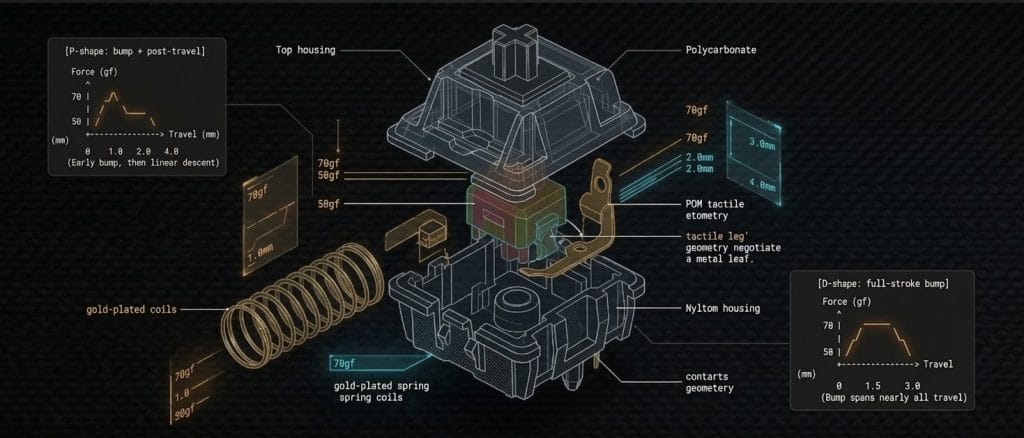
A P-shape tactile bump sits at the very top of the stroke, followed by a stretch of linear travel before bottom-out. LumeKeebs’ product database maps the Drop + Invyr Holy Panda this way: a rounded bump, then a glide. You get a distinct “event,” then speed.
A D-shape tactile bump occupies nearly the whole travel. LumeKeebs documents the Gazzew Boba U4T with exactly this profile — little to no pre-travel, little to no post-bump linear zone, one continuous tactile motion. The Sillyworks x Gateron Type R pushes the idea to its limit: Gateron’s own spec page describes tactility that “starts at the keypress and ends with the bottom-out.”
Neither is objectively better. P-shape suits typists who want confirmation-then-glide; D-shape suits those who want feedback through the entire stroke. Decide this first — it matters more than spring weight.
Switch Housing Materials: Why Polycarbonate Clacks and Nylon Thocks
A switch’s voice is set by the density and elastic modulus of its polymers.
Polycarbonate (PC) has high surface hardness, so PC top housings reflect high-frequency acoustic energy rather than absorbing it. Paired with a POM stem, the result is the crisp, high-pitched “clack” of the Zealio V2 and Durock T1.
Nylon (PA66) does the opposite: it absorbs high-frequency vibration, damping stem-rail impacts into the deeper signature the hobby calls “thock.” The Boba U4T V2’s proprietary blend and the Type R’s full-nylon shell both live on this end of the spectrum.
POM stems deserve their own mention. Polyoxymethylene has an inherently low friction coefficient — effectively self-lubricating — which is why it fills the stem column for six of the seven switches here and holds its smoothness across millions of actuations.
Plate Materials and Mounting: The Half of Switch Sound Nobody Reviews
Here’s the part most switch roundups skip entirely: the same switch sounds different in different keyboards.
Tray-mount cases bolt the plate straight to the chassis, transmitting every stem impact into the case body. That’s the origin of metallic case ping and hollow resonance in foamless budget boards — often blamed on the switch, actually caused by the mount.
Gasket-mount cases suspend the plate on elastomeric strips. The dampeners isolate switch vibration from the outer chassis, letting the switch’s own housing acoustics dominate. This is why enthusiast reviews and your budget board can describe the same switch so differently.
Plates filter sound before the case hears it. Rigid aluminum and brass reflect high frequencies, brightening clacky switches like the Zealio V2 and Holy Panda. Flexible polycarbonate, POM, and FR4 plates absorb those frequencies instead — which is why deep switches like the Boba U4T V2 pair best with them, especially over dense latex or silicone case foam.
Practical rule: match bright switches to rigid plates if you want maximum clack, and deep switches to flexible plates in gasket boards if you want maximum thock.
The Best Tactile Switches of 2026, Reviewed
1. Gazzew Boba U4T V2 — Best Overall Tactile Switch
For builders who want maximum thock and a slop-free keypress without ever touching a lube brush, this is the endgame candidate.
Overview. Manufactured by Outemu to Gazzew’s design, the U4T V2 uses a proprietary “Boba” plastic blend in both housing halves and a long-pole POM stem. Per LumeKeebs’ teardown notes, the V2 revision brings centered housings with rounder edges and swaps the V1’s soft pins for hard pins that resist bending during hot-swap installation.
Core Specs
- Top / bottom housing: proprietary “Boba” plastic blend
- Stem: POM, long-pole, MX-compatible
- Springs: Korean stainless steel — 62g, 68g, plus a newer 63.5g long-spring option (ThockKing)
- Travel: near-zero pre-travel; long-pole stem bottoms out early (~3.3mm effective; some vendor sheets list 4.0mm nominal)
- Mount: 5-pin PCB
Performance Under Load. LumeKeebs’ review describes a pronounced D-shape bump with a deep, full downstroke and a higher-pitched, poppy upstroke. Housing tolerances are tight enough that the same review calls switch films unnecessary — a rarity at any price. ThereminGoat’s community notes flag the flip side: those tight top housings can bind non-Outemu stems during frankenswitch experiments.
Pros
- Class-leading deep “thock” with minimal stem wobble in stock form
- Tolerances tight enough to skip aftermarket switch films entirely
Cons
- Keebworks’ long-term test logged spacebar and backspace chattering emerging around day 4–5 of continuous use — a leaf-contact QC variance worth watching
- Tight housings restrict stem cross-compatibility for frankenswitch builders
Best For. Builders assembling gasket-mounted boards with thick PBT keycaps who want the deepest stock sound available with zero manual tuning.
Verdict. LumeKeebs’ teardown-backed review and ThockKing’s 62g/68g Korean-spring spec sheet make the U4T V2 the most complete stock tactile package in this roster — the benchmark everything else here is measured against.
2. Drop + Invyr Holy Panda — Best Enthusiast Reference Tactile
The switch that defined an era of the hobby — and still the reference point every “rounded bump” gets compared to.
Overview. The Holy Panda is a productized frankenswitch: polycarbonate top, Invyr nylon bottom, POM Halo stem, 67g bottom-out spring. LumeKeebs’ database maps its force curve as a P-shape — a rounded bump at the top of the stroke, then linear travel to a 4.0mm bottom-out.
Core Specs
- Top housing: polycarbonate; bottom housing: Invyr nylon
- Stem: POM Halo
- Spring: 67g bottom-out, single-stage stainless steel
- Travel: 4.0mm total; early rounded bump
- Mount: 3-pin plate
Performance Under Load. Keebworks’ review confirms the 67g weighting stays comfortable across long sessions — and documents the known weaknesses: stock spring ping and scratchiness on slow, off-center presses. The legacy Invyr tooling runs looser than modern molds, producing stem wobble that tall SA or MT3 keycaps amplify. MKB Guide notes newer Drop-distributed batches use updated tooling to hold consistency while keeping the classic clacky profile.
Pros
- Bright, poppy bottom-out clack with unmistakable character — the sound that launched a thousand builds
- The rounded early bump with linear follow-through is gentle on fingers over long sessions
Cons
- Keebworks documents stock spring ping and scratch; hand-lubing with Krytox GPL 205g0 is effectively mandatory for a clean result
- Loose legacy tolerances mean 0.125mm PC switch films are commonly needed to kill housing rattle
Best For. Purists who want the authentic sound and feel of the classic custom-keyboard era and don’t mind an evening of lubing to earn it.
Verdict. Unlike every newer switch in this roster, the Holy Panda holds its slot on history and character rather than stock refinement — LumeKeebs’ P-shape curve mapping is still the profile other tactiles get measured against.
3. Sillyworks x Gateron Type R — Best No-Pretravel Tactile
What happens when a design team deletes every millimeter of linear travel from a tactile switch? This.
Overview. Co-developed by Sillyworks and manufactured by Gateron, the Type R compresses total travel to 3.0mm and fills essentially all of it with tactile event — Gateron’s product page states the goal plainly: a “100% pure tactile switch.” Both housing halves are red opaque PA66 nylon with a closed-over LED slot carrying the Sillyworks logo; the stem is a red POM long-pole.
Core Specs
- Top / bottom housing: red opaque PA66 nylon, closed LED slot
- Stem: POM long-pole
- Spring: 22mm KOS double-stage extended; 55g actuation / 60g bottom-out
- Travel: 3.0±0.2mm total; 2.2mm operating position
- Factory lube: mixed GPL 105/205 on leaf, stem feet, and bottom-housing rails (Divinikey spec log)
- Mount: 5-pin PCB
Performance Under Load. UniKeys’ teardown found the GPL 105/205 factory coat evenly spread on stem legs and bottom rails, calling the stock experience excellent “just the way they were made.” The bump is a moderate D-shape rather than a steep wall, which lets the short travel feel fast instead of fatiguing. Reddit batch reports flag the weak spot: roughly 10% of some runs exhibit double-typing under lateral north-south pressure, worst with tall SA/MT3 keycaps.
Pros
- Instant tactile engagement plus a snappy 22mm double-stage spring return — built for typing speed
- UniKeys rates the factory lube job among the best stock tactile experiences currently shipping
Cons
- The closed-slot, opaque red PA66 housing blocks nearly all RGB pass-through (MechanicalKeyboards.com spec listing)
- Documented ~10% batch susceptibility to double-actuation under off-center presses with tall keycaps
Best For. Fast typists and gamers who want immediate feedback and rapid resets, on boards where RGB isn’t a priority.
Verdict. At 3.0mm of travel with a 55g/60g force spec confirmed by MechanicalKeyboards.com, the Type R is the most structurally original switch in this lineup — order a 10% surplus to filter batch defects and it rewards you.
4. Akko V3 Creamy Purple Pro — Best Budget Tactile Switch
Proof that a genuinely satisfying tactile switch doesn’t need to cost anywhere near premium money.
Overview. The Creamy Purple Pro targets high-volume typists with an ultra-light 30±5gf operating force climbing to a 55±5gf tactile peak positioned right at the top of the stroke — 0.5mm peak position, per Akko’s official listing. Kbd.news’ data sheet lists a PC top housing, PA nylon bottom, a PA polyamide “Pro” stem, and a 21.5mm spring.
Core Specs
- Top housing: translucent purple polycarbonate; bottom: PA nylon
- Stem: self-lubricating Nylon “Pro” blend
- Force: 30±5gf operating / 55±5gf tactile peak
- Travel: 3.0mm total; 2.0±0.6mm pre-travel spec; 0.5mm bump peak position
- Mount: 5-pin PCB; sold in 45-packs
Performance Under Load. Akko’s listings document dry-lubed rail slides that suppress high-frequency friction without wet-lube migration. The 3.0mm total travel is 25% shorter than the standard 4.0mm MX stroke — a real, measurable reduction in finger travel per keypress, and the core reason this switch suits writers and data-entry work. Stem wobble sits at typical budget-tier levels: present, not distracting.
Pros
- Sold in 45-packs, keeping full-board builds and spare stock economical
- The 30gf operating force is among the lightest tactile entry points in production, easy on hands across long writing blocks
Cons
- The translucent purple top housing tints white LEDs toward a pinkish-purple cast (documented on Akko’s own store listings)
- The light spring softens the upstroke return versus 60g+ alternatives; heavy-handed typists may find it under-sprung
Best For. Writers, students, and data-entry professionals outfitting a first custom board — or bulk-buying for several — on a tight budget.
Verdict. On kbd.news’ published 30gf/55gf force data alone, the Creamy Purple Pro delivers the best force-curve-per-dollar in this roster — no other budget tactile here matches its combination of light actuation and dry-lubed consistency.
5. Gateron Zealio V2 (67g) — Best Ultra-Tactile Premium Switch
For typists who suspect every other “tactile” switch is secretly a linear with an opinion.
Overview. Designed by ZealPC and manufactured by Gateron, the Zealio V2 uses a custom convex leaf geometry to generate a large, sharp bump that begins at the very top of the stroke with zero pre-travel. MKB Guide’s deep dive notes the V2 revision (late 2018) has served as an industry tactility benchmark ever since. Transparent PC top, nylon base.
Core Specs
- Top housing: transparent polycarbonate; bottom: nylon
- Stem: purple POM
- Spring options: 62g, 65g, 67g, 78g bottom-out (ZealPC official listing) — 67g evaluated here
- Travel: 4.0mm total; bump starts at 0mm
- Factory lube: none — ships dry (MechanicalKeyboards.com spec sheet)
- Mount: 5-pin PCB
Performance Under Load. ZealPC’s listing highlights housing tolerances designed to keep stem wobble below Holy Panda levels, and community measurements bear that out — vertical and lateral play are among the lowest here. The trade-off: the switch ships unlubed, and Reddit review synthesis consistently reports dry spring grind and metallic leaf ping in stock form. Hand-lubing rails and springs is reported to cut upstroke clatter substantially.
Pros
- One of the sharpest, most immediate tactile bumps in production, courtesy of the convex leaf design
- Transparent PC top gives unobstructed RGB transmission — rare among heavy tactiles
Cons
- Ships completely dry; spring ping and leaf tick are near-guaranteed until you lube it yourself (Tribosys 3203 on rails, Krytox GPL 105 on springs)
- Sits at the premium end of the tactile market; outfitting a full-size board adds up
Best For. Experienced builders who already own lube and a brush, want maximum tactile sharpness, and treat switch tuning as part of the hobby.
Verdict. Per ZealPC’s own four-spring spec sheet and sub-Holy-Panda wobble tolerances, the Zealio V2 remains the reference for aggressive tactility — as long as you accept that the final 10% of its performance is assembled at your desk.
6. Durock T1 — Best Mid-Range Sharp Tactile
The quiet overachiever of the tactile market: boutique-grade smoothness at a corner-store price.
Overview. The Durock T1 (manufactured by JWK) pairs a polycarbonate top and nylon bottom with a POM stem and a gold-plated 67g spring. Divinikey’s technical notes distinguish its bump as stepped and crisp — a defined shelf early in the downstroke — rather than the rounded, prolonged Holy Panda profile.
Core Specs
- Top housing: polycarbonate; bottom: nylon
- Stem: POM
- Spring: gold-plated, 67g bottom-out (Mechboards UK spec listing)
- Travel: 4.0mm total; 2.0mm pre-travel
- Mount: 5-pin PCB
Performance Under Load. Keebworks’ review notes the T1 feels smoother out of the box than several more expensive alternatives — an unusual finding at this price. Factory lube consistency is decent but imperfect; some units show spring ping and light housing rattle. Keebworks also logs a rare binding defect: the stem can stick down on slow, off-center presses of wide modifier keys like Right Shift.
Pros
- Stepped, crisp tactility with out-of-box smoothness Keebworks rates above pricier rivals
- One of the strongest price-to-performance ratios in the tactile segment
Cons
- Documented rare stem binding on slow off-center presses of wide modifiers
- Batch-level lube inconsistency; springs may need a bag-lube pass to silence ping
Best For. Builders who want a sharp, defined 67g bump across a whole board without paying enthusiast-tier prices.
Verdict. Mechboards’ 67g gold-spring spec and Keebworks’ smoothness findings make the T1 the roster’s value anchor — the switch to name when someone asks for “Zealio feel, half the price.”
7. TTC Silent Bluish White V2 — Best Silent Tactile Switch
A tactile switch your office neighbors will never hear — and your fingers won’t mistake for a wet sponge.
Overview. The Silent Bluish White V2 attacks the classic silent-switch problem — mushiness — with what TTC calls a double-safety silencing structure. LumeKeebs’ teardown documents a high-hardness silicone muffler in the base plus an inner square silicone ring on the stem, damping both bottom-out and top-out while a POM partial-box stem keeps the stroke rigid.
Core Specs
- Top housing: polycarbonate; bottom: PA66 nylon
- Stem: POM partial-box, dustproof walls
- Spring: double-coiled stainless steel; 42±10g actuation / 50g bottom-out (MechanicalKeyboards.com spec sheet)
- Travel: 3.5±0.4mm total; 2.0±0.4mm pre-travel
- Mount: 3-pin plate
Performance Under Load. MechanicalKeyboards.com’s listing confirms the 42g/50g force pairing and 3.5mm travel; kbd.news’ force-curve data places the 60g bump peak at just 0.30mm into the stroke, so feedback arrives immediately. LumeKeebs’ testing found bottom-out noise comparable to a membrane office board. Reddit consistency threads note a small percentage of units (~2%) can develop upstroke clatter over time if factory lube migrates.
Pros
- Dual dampening silences both stroke directions while the rigid partial-box stem avoids the mushy bottom-out typical of silent switches
- Immediate bump (0.30mm peak position) with a light 42g actuation — comfortable for all-day office typing
Cons
- 3-pin plate-mount housing offers less PCB-level stability than 5-pin rivals
- Small documented batch percentage (~2%) develops upstroke clatter if factory lube is uneven
Best For. Anyone typing in a shared office, on calls, or next to a sleeping partner who still refuses to give up tactile feedback.
Verdict. Between MechanicalKeyboards.com’s 42g/50g spec confirmation and LumeKeebs’ membrane-level noise finding, this is the rare silent tactile that solves the noise problem without creating a feel problem.
Known Defects, Documented: The QC Table No Other Guide Publishes
Every switch here has a documented failure mode. Knowing it before you buy beats discovering it after you’ve soldered.
| Switch | Documented Defect | Source | Practical Mitigation |
| Gazzew Boba U4T V2 | Spacebar/backspace chattering emerging after ~4–5 days of continuous use | Keebworks long-term review | Keep 5–10 spares; swap affected switches |
| Drop + Invyr Holy Panda | Stock stem wobble, spring ping, off-center scratch | Keebworks review | Krytox GPL 205g0 hand-lube + 0.125mm PC films |
| Sillyworks x Gateron Type R | ~10% of some batches double-type under lateral N-S pressure with tall keycaps | Reddit r/MechanicalKeyboards batch reports | Buy a 10% surplus; avoid SA/MT3 caps on affected units |
| Akko V3 Creamy Purple Pro | Purple housing tints white LEDs pinkish-purple | Akko store listings | Opaque keycaps or matching LED colors |
| Gateron Zealio V2 | Dry spring grind and metallic leaf ping out of box | Ships unlubed per MechanicalKeyboards.com; Reddit review synthesis | Tribosys 3203 on rails; Krytox GPL 105 bag-lube on springs |
| Durock T1 | Rare stem binding on slow, off-center wide-modifier presses | Keebworks review | Film + lube pass; test Right Shift before full install |
| TTC Silent Bluish White V2 | ~2% develop upstroke clatter over time from lube migration | Reddit consistency threads | Keep spares; re-lube affected stems |
How to Choose a Tactile Switch: 7 Things That Actually Matter
Bump geometry before bump strength. A 67g P-shape and a 67g D-shape feel like different species. Decide event-then-glide (Holy Panda) versus wall-to-wall feedback (Boba U4T V2, Type R) before comparing spring weights.
Stem wobble scales with keycap height. Moderate wobble feels fine under Cherry-profile caps and sloppy under SA or MT3. Running tall caps? Prioritize the tight-tolerance options: Boba U4T V2 and Zealio V2.
Factory lube is a spectrum, not a checkbox. The Type R ships with an even GPL 105/205 coat; the Zealio V2 ships bone dry; the T1 lands between batches. Budget tuning time accordingly.
Spring ping is a spring problem, not a housing problem. Metallic ring from dry coils is fixed with a bag-lube of high-viscosity oil like Krytox GPL 105 — cheap insurance for the Holy Panda and Zealio V2.
Silent dampeners trade rigidity for noise. TPU and silicone pads soften bottom-out by design. The TTC Silent Bluish White V2 minimizes this with a rigid partial-box stem, but no silent switch bottoms out exactly like its non-silent sibling.
Match the switch to your mount and plate. Bright switches (Zealio V2, Holy Panda) shine on rigid aluminum or brass; deep switches (Boba U4T V2) reward flexible PC, POM, or FR4 plates in gasket-mounted cases.
Version numbers are load-bearing. The Boba U4T V2 is not the silent U4. The Silent Bluish White V2 is not the non-silent Bluish White V2. The Holy Panda is not the Holy Panda X. Check the exact model string before checkout.
Frequently Asked Questions
What is the difference between tactile and linear switches?
A tactile switch produces a physical bump partway through the keypress — resistance from the stem legs riding over the metal contact leaf — confirming actuation by feel. A linear switch has no bump; force rises smoothly from top to bottom of the stroke. Tactile switches suit typists who want feedback per keystroke; linears suit gamers who want uninterrupted travel for rapid repeated presses.
What’s the physical difference between a P-shape and a D-shape tactile bump?
The difference is where the bump sits in the stroke. In a P-shape switch like the Drop + Invyr Holy Panda, a rounded bump sits at the top of the keypress, followed by linear travel to bottom-out (LumeKeebs product database). In a D-shape switch like the Gazzew Boba U4T V2, the bump spans nearly the entire travel, so the whole downstroke reads as one continuous tactile event.
Does spring weight change how tactile a switch feels?
Indirectly, yes. The bump shape comes from the stem leg geometry, but the spring sets the resistance baseline underneath it — so a heavier spring makes the same bump feel less prominent relative to the total force, while a lighter spring makes it stand out. That’s why the 30gf Akko Creamy Purple Pro feels distinctly bumpy despite a modest 55gf peak.
How do I deal with the double-pressing reported on the Sillyworks x Gateron Type R?
Reddit batch reports attribute the issue to lateral north-south pressure on the stem, worst with tall SA/MT3 keycaps, affecting roughly 10% of some runs. Practical fixes: order about 10% more switches than the board needs and swap affected units, and prefer lower-profile keycaps on this switch. Leaf adjustment with tweezers is possible but risks ruining the switch.
Why do my Gateron Zealio V2 switches ping, and how do I fix it?
Zealio V2s ship unlubed from the factory (MechanicalKeyboards.com spec sheet), so dry spring coils and leaf contacts resonate freely inside the rigid PC top housing. Brush a thin coat of Tribosys 3203 on the slider rails and bag-lube the springs with Krytox GPL 105. Avoid heavy lube on the leaf itself — it dulls the bump you paid a premium for.
Is the TTC Silent Bluish White V2 actually silent, and does it feel mushy?
It’s genuinely quiet — LumeKeebs’ testing compares its bottom-out noise to a membrane office keyboard. Mushiness is minimized by design: the silencing comes from a base muffler and a stem ring rather than soft rail pads, and the POM partial-box stem keeps the stroke rigid. Expect a slightly softer bottom-out than a non-silent switch, nothing like older silent designs.
Do I need 5-pin switches, or are 3-pin switches fine?
5-pin switches add two plastic guide legs for extra PCB stability; 3-pin switches omit them. On plate-mounted or gasket-mounted boards, 3-pin switches (Holy Panda, TTC Silent Bluish White V2) work perfectly. If a hot-swap PCB only accepts 3-pin, the plastic legs on any 5-pin switch clip off in seconds.
How We Researched This
This guide was compiled using a synthesis-based research methodology. Technical specifications come from official manufacturer spec sheets. Acoustic and typing-feel observations are drawn from published independent reviews (cited by name where they exist) and from the wider mechanical-keyboard enthusiast community.
No hands-on units were physically tested for this guide. Instead, we cross-referenced technical data and reviewer findings across multiple independent sources to compile an objective, comparative analysis. Where a claim reflects a manufacturer’s own rating rather than an independent measurement, we say so. For more details on our standards, please visit our dedicated Methodology page.
The Switch to Solder First
If you’re buying one set of tactile switches in 2026, buy the Gazzew Boba U4T V2. It’s the only switch in this roster where the stock experience — tolerances, lube, acoustics — needs nothing from you, and LumeKeebs’ finding that it doesn’t even need switch films is a claim no other switch here can match.
Chasing maximum sharpness? Zealio V2, plus an evening of lubing. Building on a tight budget? The Akko V3 Creamy Purple Pro. Typing next to coworkers? TTC Silent Bluish White V2, no contest.
Torn between two? Grab a switch tester first — sampling five candidates costs far less than committing to one wrong 70-pack.